
The frigidaire trash compactor repair or replace question has a twist that most appliance decisions do not: these units are discontinued. Frigidaire no longer makes trash compactors, and the TC and TCU family survives only as legacy stock and repair parts. That means the deciding factor is often not just the cost of the fix but whether a genuine OEM part for your model still exists at all.
This guide sorts the situation into clear repair-leaning and replace-leaning signals so you can place your own compactor on that scale before spending anything.
When a frigidaire trash compactor repair or replace call leans toward repair
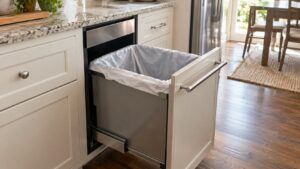
Lean toward repairing when the unit is mechanically sound, the failed part is minor, and that part is still available. A worn drawer or safety switch, a drive belt or chain, a set of power nuts, or a deodorizer filter are the kinds of parts that bring a compactor back to full use for a reasonable outlay, provided they can still be sourced. If your compactor is built into a cabinet run, a working repair also saves you the awkward job of filling or refacing a 15-inch gap in the cabinetry, which is a real consideration with a built-in unit. Our guides on a unit that will not start and a stuck ram help you pin down which part has failed.
When it leans toward replacement or removal
The picture changes when the failure is major or the parts have dried up. Consider replacing the unit, or converting the space to a pull-out bin or cabinet, when:
- The failed part is no longer manufactured and no genuine OEM stock can be found for your model.
- The problem is a major drive failure, a seized motor, or stripped power screws, where the labor is heavy on an already old appliance.
- The compactor is decades old and other parts are visibly worn, so one fix is likely to be followed by another.
- You rarely use it, in which case a simple recycling and bin setup may serve better than any compactor.
Because no new Frigidaire compactor exists to buy as a like-for-like swap, replacement here often means a different brand still in production or repurposing the cabinet space entirely, which is worth factoring into the decision.
Do not overlook the value of the cabinet space itself in this decision. A built-in compactor occupies a 15-inch run that, if you remove the unit, leaves a gap to fill with a cabinet, a pull-out bin, or a recycling station. For some households that conversion is a welcome upgrade; for others, keeping a working compactor in that slot is simpler and cheaper than any cabinetry work. Weigh what the space would otherwise become before you treat replacement as the obvious answer.
Let a confirmed diagnosis and a parts check lead
The smart first move is to have the actual problem identified and the part availability checked together, since on a discontinued unit those two answers decide everything. A compactor that needs only an in-stock switch is an easy repair; the same compactor needing a long-obsolete drive assembly is not. An experienced technician can diagnose the problem and tell you honestly whether the part can still be obtained before you commit. There are no error codes to read on these units, so a hands-on look is the only way to know.
Book Frigidaire trash compactor service
For an honest diagnosis and a real parts check before you decide, our experienced, independent technicians service Frigidaire trash compactors with genuine OEM parts where available and a 30-day labor warranty. Schedule a visit, see what our trash compactor repair service covers, or confirm your model details at frigidaire.com.