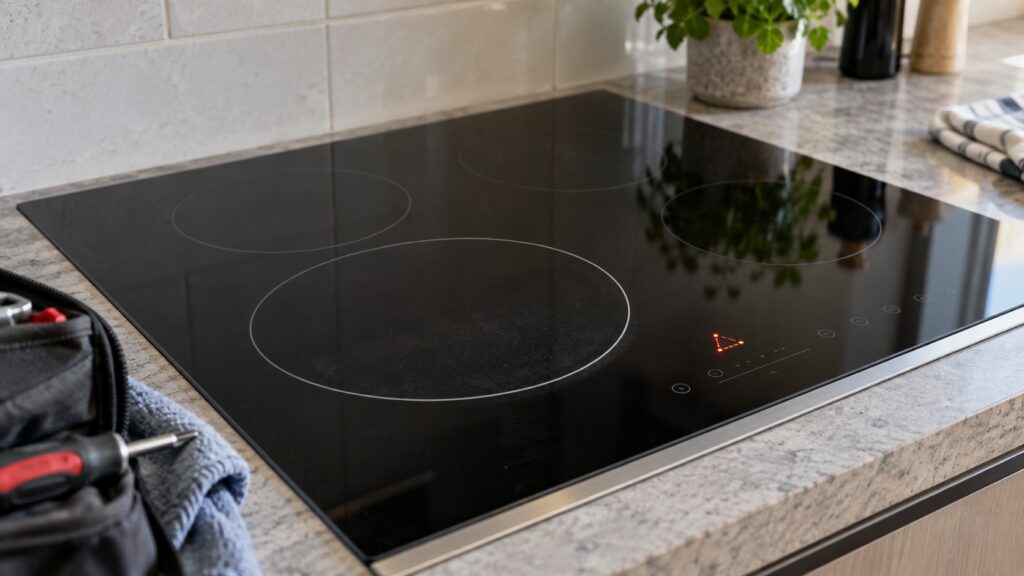
On an induction cooktop, a frigidaire cooktop e1 code is an element thermistor problem — the temperature sensor under the glass for that cooking zone is reading outside the range the control trusts. E6, on the same cooktop, is a cooling-fan failure. They look similar on the panel and they are not the same job at all: one is a sensor telling a wrong story, the other is a fan that has stopped protecting the electronics underneath.
What does E1 mean on a Frigidaire induction cooktop?
Every induction zone has a thermistor pressed against the underside of the ceramic glass. It is not there to cook by — induction heats the pan, not the surface — it is there to protect the glass and the coil beneath it from a pan boiled dry or a pot left empty over a coil at full power. The control watches that reading constantly.
E1 appears when the value stops making sense: an open circuit reads as impossibly cold, a shorted one as impossibly hot, and a loose connector flickers between the two. The control will not run a zone whose temperature it cannot trust, so it shuts that zone down and posts the code, usually while the other zones keep working normally.
Can E1 be caused by something other than a failed sensor?
Yes, and it is worth ruling those out before anyone talks about parts. A thermistor that has come unstuck from the glass reads the air under the cooktop instead of the surface, which looks like a fault the moment a pan gets hot. A cooktop installed directly above a wall oven that has just finished a self-clean cycle can be genuinely overheated from below, and the sensor is reporting the truth.
Spilled liquid that has found its way under the glass is the third case. Sugar syrup and salted water are conductive enough to change what a sensor circuit reads, and they arrive through the seal around the glass edge after a boil-over. If E1 showed up the day after a pot overflowed, that is the lead worth following.
Why is E6 more urgent than the rest?
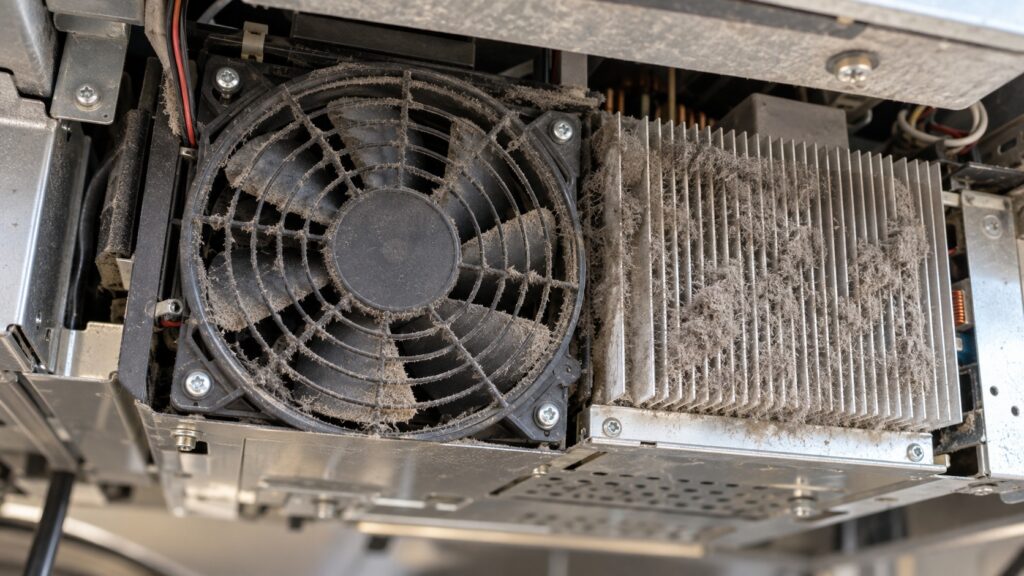
An induction cooktop is a power electronics box with a glass lid. The inverter under each zone throws off real heat, and a fan pulls air through the chassis to carry it away. E6 means that fan is not turning, or is turning too slowly for the control to accept.
Run a cooktop in that state and the inverter board is cooking itself. Many installations put the fan intake in a narrow gap between the cooktop and the drawer or oven beneath it, where lint and cooking grease collect over years until the blade is packed solid. The board that fails afterward is far more expensive than the fan that started it, which is why E6 is the code we ask people to stop for.
What can I check safely from above?
Everything on this list is done without removing the cooktop.
- Let it cool, then power cycle at the breaker for five minutes. A code thrown by a one-time overheat clears and does not come back.
- Listen for the fan after switching a zone on at high power for a minute. Silence where there used to be a low hum is the answer.
- Check the vent gap below the front edge or under the counter overhang. A towel, a cutting board or a drawer stacked to the top can block the intake completely.
- Note which zone reports E1, and whether the code follows the pan or stays with the zone. A code that follows the pan is not a sensor fault.
- Look for a boil-over trail along the glass edge seal. That tells you where a liquid has gone.
🔴 Stop there. The cooktop is held in the counter cutout by clips, the glass sits in a metal frame that flexes, and the underside carries line voltage terminals and capacitors that hold a charge after the breaker is off. Lifting an induction cooktop out is a two-person job with the power proven dead.
Is a blank or locked cooktop the same problem?
No, and mixing them up sends people looking for sensors when the cooktop is simply locked. F40, shown with F41 on these models, is a control lock-out rather than a component fault. A cooktop that lights up but refuses every touch is usually in child lock or a control lock-out state, and our guide to a cooktop that will not turn on covers that path.
A zone that lights up and simply does not warm the pan is different again — often a pan that is not ferrous, so induction has nothing to couple to. Our element not heating guide works through that, and a refrigerator magnet on the pan base settles it in two seconds.
What does routine care actually prevent?
Two things, and both are cheap. Keeping the vent path clear prevents E6 outright, because the fan that fails is almost always the fan that has been breathing lint for years. Wiping boil-overs off the glass edge before they dry prevents liquid from tracking under the seal toward a thermistor. Our cooktop cleaning guide covers the surface routine that keeps the seal intact.
It is also worth being honest about what these codes are not. Neither E1 nor E6 means the glass is damaged, and neither means the cooktop has to be replaced. They name a sensor and a fan — two of the least expensive parts in the appliance — and the cost of ignoring them is what turns them into a board.
When should you call?
Call when E6 is present at all, when E1 returns after a power cycle and stays with one zone, when more than one zone reports a code, or when the cooktop shuts itself down part-way through cooking. Those need the unit lifted and the underside measured, with the power proven dead first.
We are an independent repair company and not a factory service arm. Pricing starts from a diagnostic visit, from $89 in most areas, and we confirm the estimate before any work begins. Frigidaire cooktop repair covers induction sensors, fans, inverter boards and touch controls, and you can schedule a visit online or call (844) 440-7025.