How a Frigidaire trash compactor works comes down to one motor, one gear train and a handful of switches. When you close the drawer and turn the key-knob, the motor drives a steel ram down into a removable bin, squeezes the bag against the bottom, then reverses and lifts the ram back up. There is no control board and no error code anywhere in the process: every decision is made by a mechanical switch, which is why the machine is so durable and also why every fault has to be found by watching what the ram does.
How does a Frigidaire trash compactor crush the trash?
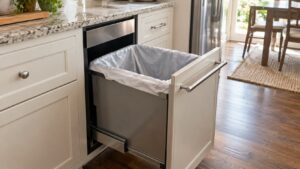
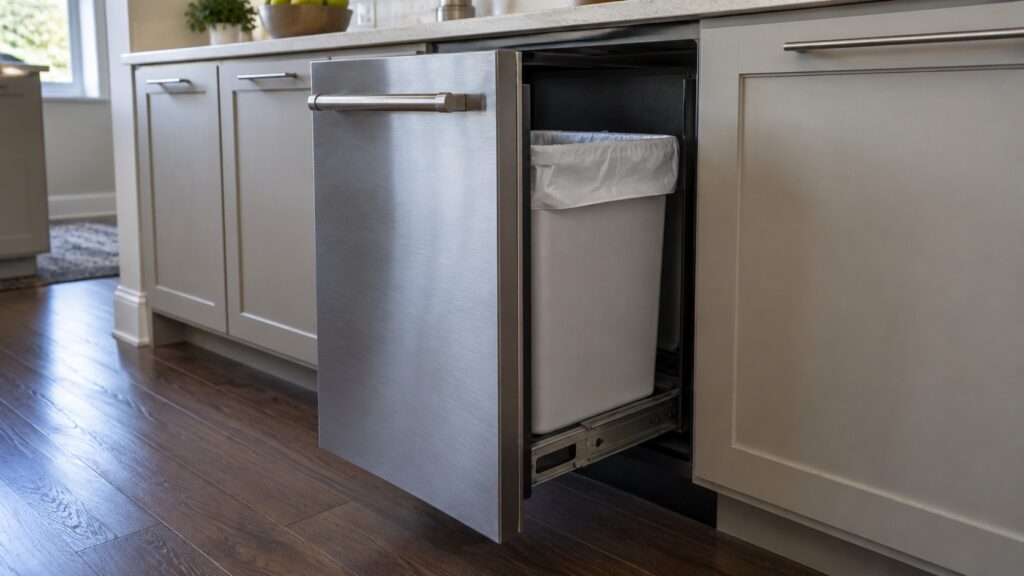
A Frigidaire compactor is a drawer-style machine. The drawer pulls out and holds a removable bin lined with a heavy bag. When the drawer slides home, it sits under a steel ram, a flat plate that travels up and down on a guided frame. On most household compactors the motor turns a gear case that moves the ram through drive screws or a chain, so a small motor can produce a very large downward force. The ram presses the trash into the bag, stops at the bottom of its stroke, and returns to the top, leaving room for the next load.
Because the force comes from gearing rather than speed, the stroke is slow. That is normal, and it is a design choice: a slow, strong stroke is easier on the motor and gives the switches time to act. If a cycle seems slower than you remember, the likely cause is a heavy load or a dry drive, not a different machine.
What keeps the ram from moving when the drawer is open?
Two switches stand between you and the ram. The first is the drawer interlock switch, a small switch that closes only when the drawer is fully in. It breaks the motor circuit whenever the drawer is open or half shut, so the ram cannot move while a hand or a bag is in the way. The second is the key-knob safety control found on models such as the TC3D4: the compactor will not start unless the key-knob is in the run position, a simple guard against children and accidental starts. Remove the key and keep it away from small hands when the compactor is not in use.
These two switches explain the most common no-start complaint. A drawer that is not seated, a bag edge hung over the rim, or a latch that is worn out can all keep the interlock open, and the compactor then does nothing at all. Our guide to a Frigidaire trash compactor that will not start works through that list, and the will-not-start page covers the symptom directly.
How does the ram know when to reverse?
The ram does not measure the trash; it travels until a switch tells it to turn around. The anti-jam directional switch listed on the TCU3D5 and TC500 series senses the end of travel and flips the motor to run the other way, which raises the ram back up. If the bin is overfilled or the load is packed with something rigid, such as a bottle standing on end, the ram can meet more resistance than the motor can overcome, and the same system protects the machine by reversing rather than stalling.
That protective step is the reason a ram sometimes lifts partway and drops again, or reverses before it reaches the bottom. It is the machine saying the load is too much for one stroke. Take out some trash, remove anything hard and bulky, and run it again.
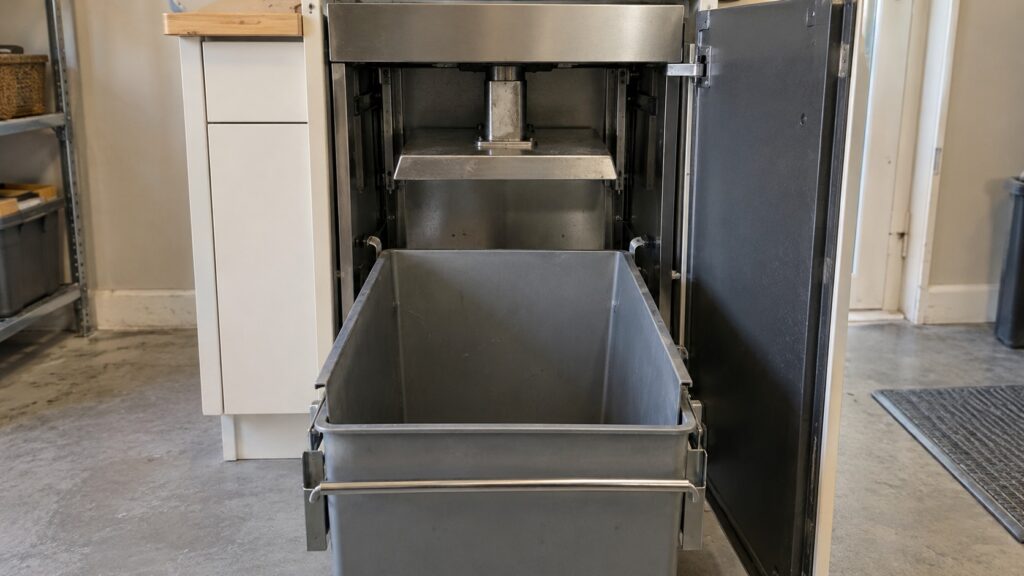
Why does a trash compactor have no error codes?
Frigidaire trash compactors are electromechanical, so there is no display and nothing to flash a code. What you have instead is a short list of parts, each tied to a symptom you can see and hear. The table below is the map technicians use, and each row matches a symptom page on this site.
The symptom pages for a stuck ram or jam and a drawer that will not latch go deeper on each, and our Frigidaire trash compactor ram stuck guide covers the jam case in full. Do not put a hand or a tool into a stuck compactor while it is plugged in. Unplug it first or switch off its breaker, because a ram freed from a jam can move with its full force.
What habits keep the mechanism healthy?
Most compactor failures are habits rather than parts. Use the bags made for the machine, since a thin bag tears and spills into the drive area. Do not compact glass in quantity, aerosol cans, or anything with flammable residue. Empty the bin before it is packed to the rim, because an overfilled bag is the leading cause of a drawer that will not close and a ram that struggles. Wipe the bin and the drawer rails now and then, and replace the odor filter if your model has one. Our trash compactor maintenance guide sets out a routine, and the odor guide deals with the smell that builds in the bin.
Does the cabinet type change how it works?
Not the principle, only the fit. The TC500AWW0 is a built-in 500-series compactor, the TCU3D5 is a later undercounter revision, and the TC3D4 is a built-in that can be converted to freestanding. All of them are roughly 15 inches wide, and all use the same ram, drive and switch arrangement. Parts differ between generations, so give a technician the model number from the label before ordering anything. If a compactor is old and the drive or the cabinet is worn, our repair or replace guide will help you decide, and our Frigidaire trash compactor repair service handles the work. We are an independent service, so a diagnosis does not depend on a part we have to sell.