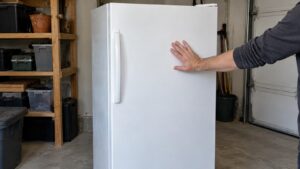
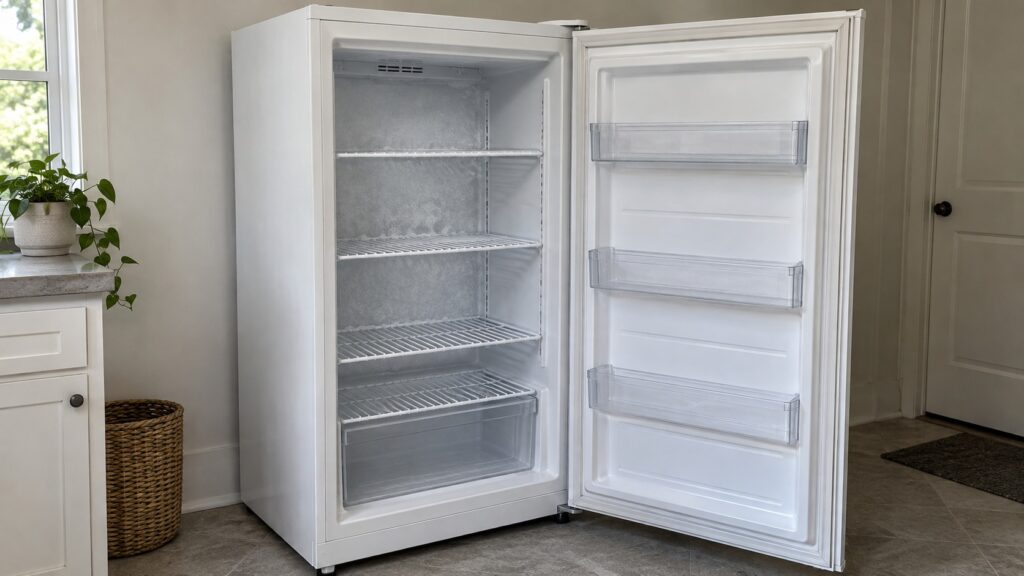
The Frigidaire freezer defrost cycle is how a frost-free model controls frost: every several hours the control stops cooling for a short time, warms the evaporator coil with a heater until the frost on it melts, drains the water away, and goes back to freezing. A manual-defrost freezer has no such cycle, which is why frost on its walls builds until you switch it off and thaw it. Knowing which kind you own, and what the cycle looks like when it works, makes it much easier to tell normal frost from a failing defrost system.
How does a Frigidaire frost-free freezer defrost itself?
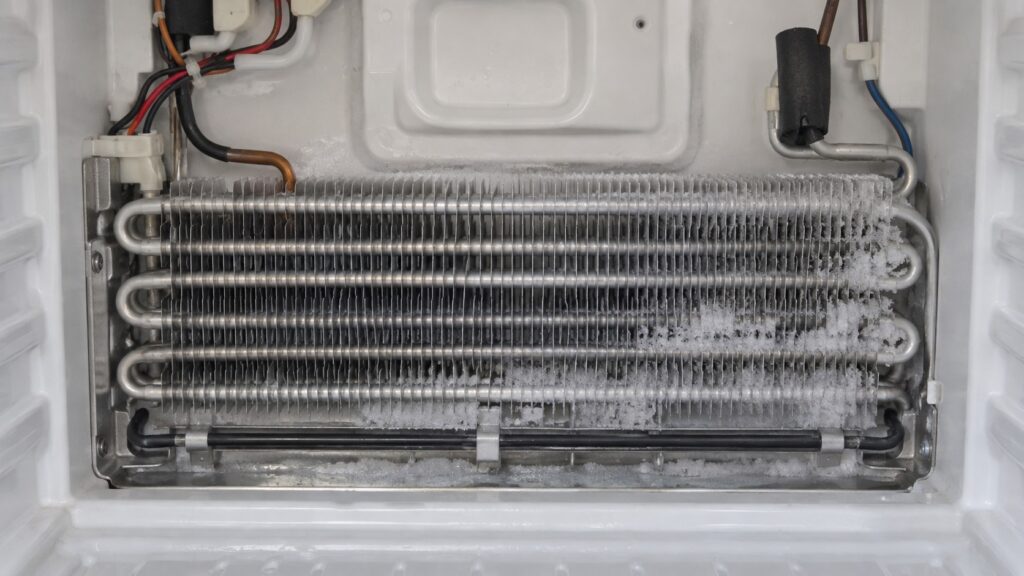
Inside a frost-free upright, the evaporator coil is the cold surface that pulls heat out of the cabinet. A fan blows freezer air across the coil and back into the cabinet through vents in a rear panel. Moisture in that air freezes onto the coil as a thin layer of frost. Left alone, the layer would thicken until it blocked the airflow, so the freezer interrupts itself on a schedule. During a defrost cycle the compressor and fan pause, an electric heater near the coil warms it, and the frost melts. A thermostat watches the coil and ends the heating when it has warmed enough, so the cabinet does not heat up for longer than necessary.
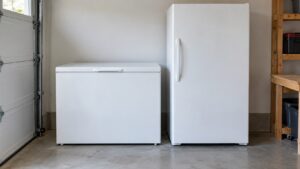
Models on our site that work this way include the FFUE2022AW, the FFFU20F2VW and the garage-ready FFFU16F2VW, all frost-free uprights. The FFFH20F2QW and the chest freezers appear in our list as setpoint-controlled units with no codes. If you are unsure which type you own, look at the rear wall: a flat panel with vent slots means a fan-driven evaporator, bare plastic with cold shelves means something else.
Where does the melted frost go?
The water runs into a drain at the bottom of the evaporator area, through a tube and into a pan near the compressor, where the warmth of the compressor evaporates it. You normally never see any of this. You notice it only when it fails, usually as one of two symptoms: water on the freezer floor, or a sheet of ice over the drain and the cabinet base. A drain that freezes shut turns each defrost cycle into a small puddle that refreezes, and over weeks the ice grows. Our Frigidaire freezer frost buildup guide walks through what to check when you see that.
What parts make the cycle happen?
Four parts matter, and knowing them helps you read a technician’s diagnosis.
- The defrost heater. A heating element attached to or beside the coil. If it fails open, the coil never warms, and frost slowly covers it.
- The defrost thermostat. A temperature switch that tells the control when the coil has warmed enough. A failed one can leave the heater on too long or not at all.
- The control or timer. The brain that starts the cycle at set intervals. A freezer whose control fails may never defrost.
- The evaporator fan. It moves air across the coil. A seized fan makes the freezer warm in one section and frosty in another.
Our model pages for these freezers mention a failed start relay or thermostat as a frequent cause when a freezer misbehaves. A start relay sits on the compressor and helps it start; a freezer with a failed relay can hum and click without ever running, which looks like a not-freezing problem with no frost at all.
What does a failing defrost system look like?
The signs arrive in a predictable order. First comes a slightly thicker layer of frost on the back wall or the vents. Next, packages near the rear stay cold but those near the door soften. Then airflow weakens, the temperature climbs, and the freezer runs more and more without catching up. Frozen food that thaws and refreezes in this stage turns grainy or develops freezer burn.
Not every frost symptom is a defrost fault, and the cheaper causes come first. A door that does not close tightly lets in humid room air, which freezes on the coil faster than any defrost cycle can clear. A door-ajar alarm sounding often is a clue. A garage-placed freezer also takes on more moisture in humid weather. Check the gasket for gaps, make sure nothing keeps the door from closing, and give the vents room. If the freezer is also not cold enough, read why a Frigidaire freezer stops freezing alongside this guide.
Can I speed up or force a defrost?
The safe way to clear a heavy frost layer yourself is a full manual defrost: empty the freezer into coolers, switch it off or unplug it, leave the door open, and catch the meltwater with towels. Do not chip ice with a knife or use a heat gun, since the coil and refrigerant lines sit inches behind the panel and a puncture is not repairable. Use a bowl of warm water placed inside to speed things up, and wipe the cabinet dry before restarting. If frost returns thickly within a few weeks, the defrost circuit is the problem and a manual defrost has only reset the clock.
What does a chest freezer do differently?
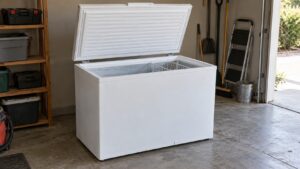
A chest freezer such as the FFFC20M4TW is a different design. Frost forms on the inside walls, because they are the cold surface, and it builds slowly over months. You remove it by hand, typically once or twice a year, or when it reaches about a quarter inch. See our guide to the Frigidaire FFFC20M4TW chest freezer and the comparison in chest vs upright freezers for how that trade-off plays out.
When the defrost system does fail on an upright, repairing it is a diagnostic job: the heater, thermostat and control are tested in turn, and the one that fails is replaced. Frigidaire freezer repair covers that, and you can book a visit whenever you are ready.