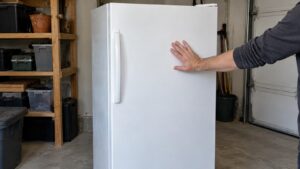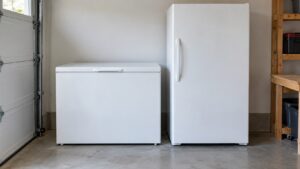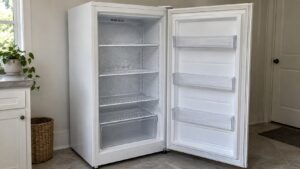
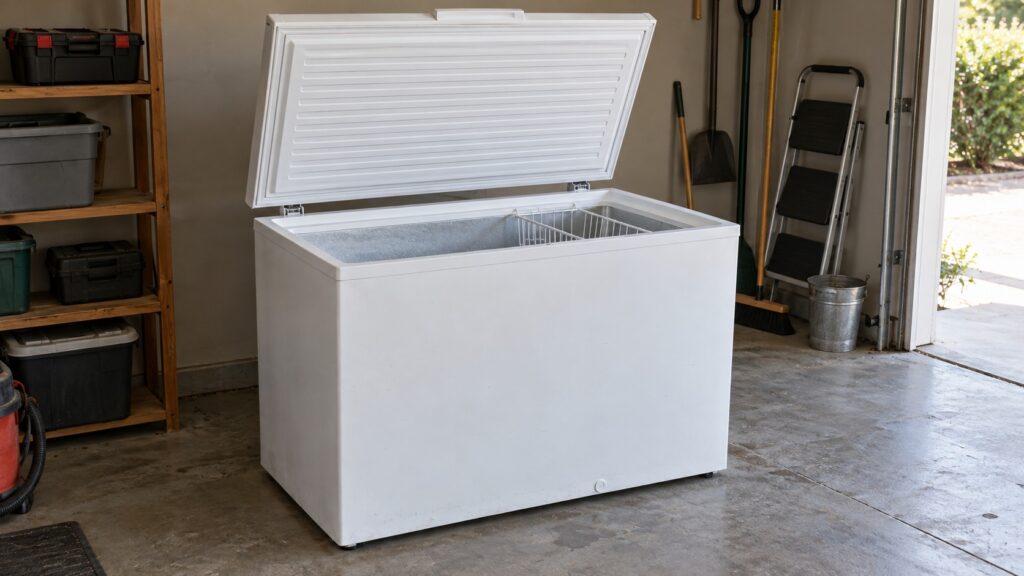
The fffc20m4tw is a 20 cubic foot manual-defrost chest freezer, and almost everything people find surprising about it follows from those two words: manual defrost. There is no fan moving air, no heater melting frost on a timer, and no defrost thermostat to fail. Cold comes off the walls themselves, and frost stays where it lands until somebody removes it.
How does a cold-wall chest freezer keep food frozen?
Refrigerant leaves the compressor, sheds its heat in a condenser, then passes through tubing bonded to the outside of the inner cabinet. The walls themselves become the cooling surface. Air inside does not need to be circulated because cold air sinks and a chest opens upward — the cold stays in the box even with the lid up, which is exactly why chest freezers recover so quickly after being opened.
There is no evaporator fan in this design, which removes a motor, a blade and a thermostat from the list of things that can fail. That simplicity is the reason chest freezers of this type routinely outlast the upright freezers bought at the same time, a trade our chest versus upright comparison covers in full.
What does the thermostat dial actually control?
Not a temperature — a run time. A mechanical thermostat senses the cabinet and decides when the compressor starts and stops, and the numbers on the dial are relative positions rather than degrees. Turning it to a higher number does not set a colder target in any exact sense; it makes the compressor run more of the time.
The practical method is to put a thermometer inside, leave it overnight, read it, then move the dial a small amount and wait another day before reading again. Anything at or below zero degrees Fahrenheit is doing its job. Chasing the dial in large steps produces a freezer that swings and a compressor that runs constantly.
Why does frost build up, and when should I defrost?
Frost is moisture that came in with the air every time the lid was opened, plus moisture from food that was not wrapped tightly. With no defrost heater, all of it accumulates on the walls, and about a quarter inch of frost is the point where it starts to insulate the cold surface from the food rather than help it.
Defrost once or twice a year, or whenever that quarter inch appears. Move the food into coolers, unplug the freezer, open the lid, and let the frost release on its own — a pan of hot water inside speeds it up safely. Never use a knife, screwdriver or ice pick: the walls carry refrigerant tubing directly behind the liner, and a puncture ends the appliance on the spot. Frost that returns within weeks of a defrost is a seal problem, not a defrost problem, and our frost buildup guide works through why.
What is the drain plug for?
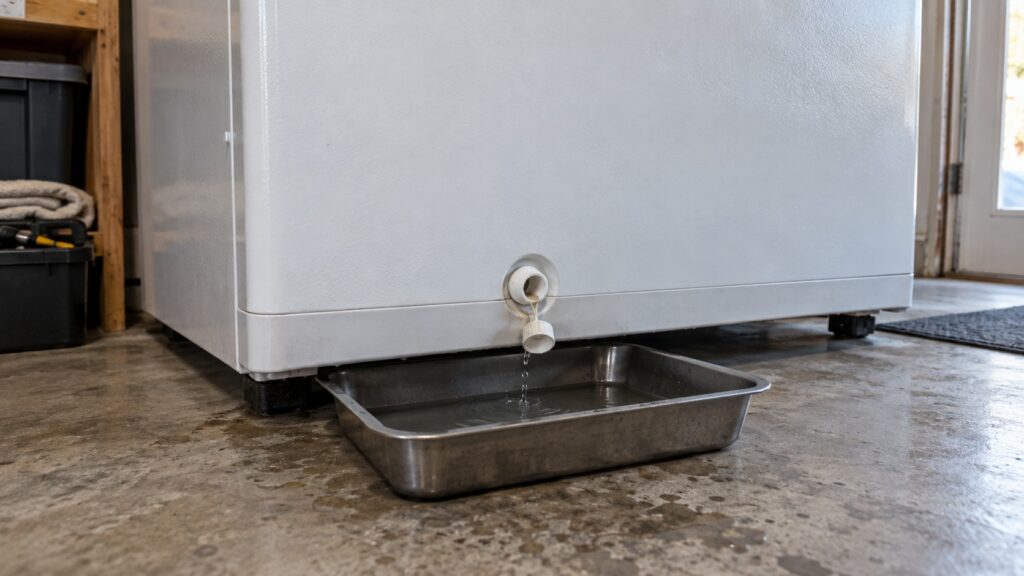
It is the one part of this freezer people forget exists. A threaded plug sits at the base of the cabinet, usually at the front, and during a defrost it is what lets meltwater run out into a shallow pan instead of pooling under the food baskets. Pull it before you start, not after.
Put it back finger tight when the cabinet is dry, with its washer seated. A plug left out or left loose is a slow air leak in the wall of an insulated box, and it shows up as an increase in frost and a compressor that runs longer than it used to.
Can a chest freezer live in a garage?
Often yes, but check the ambient rating on the nameplate first, because this is where manual-defrost freezers get an undeserved reputation. The thermostat senses cabinet temperature, and in an unheated garage in winter the cabinet may sit below the point where the thermostat calls for cooling at all. The compressor stops running, and food that should be at zero degrees drifts up toward whatever the garage is doing.
Heat is the other end of the same problem. A garage above the rated ambient forces the compressor to run nearly continuously, and a condenser choked with garage dust makes that worse. If a freezer must live out there, keep the airspace around it clear, keep the coils clean, and put a thermometer inside so you are reading the food rather than guessing.
What should I check before assuming a fault?
- The lid seal. Close the lid on a dollar bill and pull. Consistent drag all the way around means the gasket is sealing.
- Frost depth. Over a quarter inch, defrost before diagnosing anything else.
- The dial. Confirm nobody moved it while loading. It is at knee height and easy to knock.
- The outlet. A chest freezer on a switched outlet or a tripped GFCI is silently off, and the lid keeps the contents cold for a day, which delays the discovery.
- Airspace. Several inches clear on the sides and back, and nothing stored on top of the lid.
One more check costs nothing: listen. A chest freezer running normally makes a steady low hum from the compressor at the back of the cabinet and very little else, because there is no fan in the design. A rattle usually means the cabinet is touching a wall or something is resting on the lid, while a rapid click every few minutes from the compressor area means it is trying to start and failing.
If the cabinet is not holding temperature after all of that, the freezer not freezing guide is the next step, and the answer is usually the seal, the ambient, or the sealed system in that order.
When is it worth calling?
Call when a freezer with a clean seal and a cleared frost load still will not hold zero degrees, when the compressor runs without ever cycling off, when it starts and stops in short bursts, or when the cabinet is warm and silent with power confirmed at the outlet. Those are thermostat, start component and sealed-system matters, and none of them are reachable from inside the box.
We are an independent repair company and not a factory service arm. Pricing starts from a diagnostic visit, from $89 in most areas, and we confirm the estimate before any work begins. Frigidaire freezer repair covers thermostats, seals, start components and sealed systems, and you can schedule a visit online or call (844) 440-7025.