
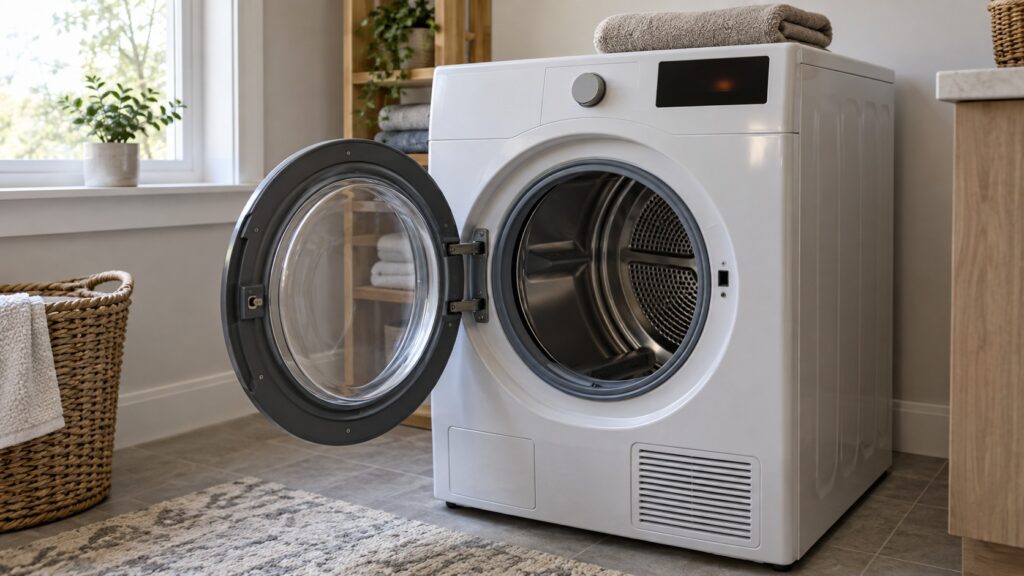
A Frigidaire dryer that will not heat can post four different codes — E24, E25, E64 or E66 — and all four look like the same complaint from the laundry room: cold clothes, a running drum, no warmth. They are not the same repair. E24 and E25 point at the thermistor that reads drum temperature; E64 and E66 point at the heating circuit itself, the element and the high-limit thermostat that protects it. Reading the code before opening the dryer tells you which half of the heat system to check first.
What do E24, E25, E64 and E66 mean on a Frigidaire dryer?
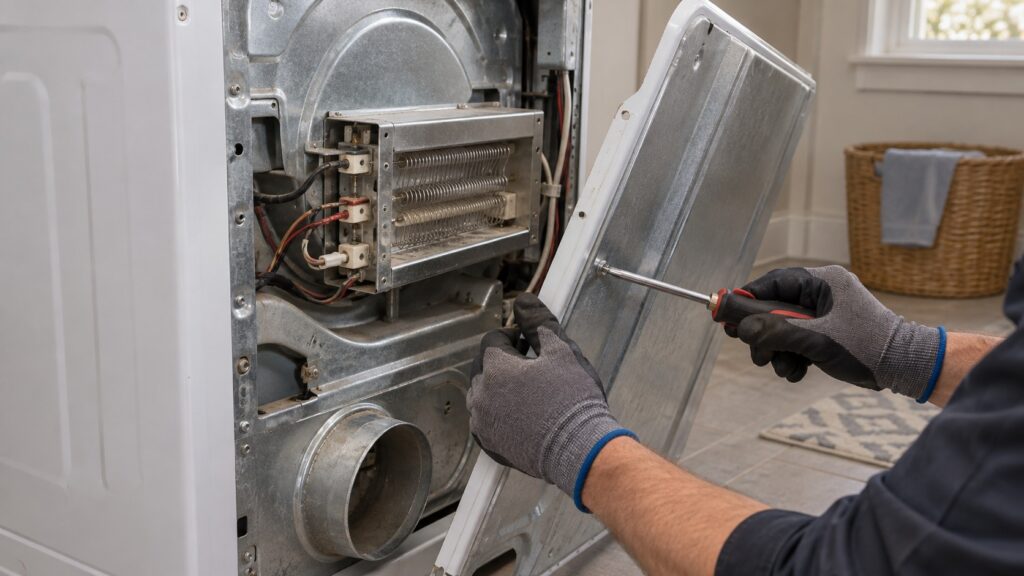
E24 and E25 both come from the thermistor, the small sensor that tells the control board how hot the drum air is. When that sensor reports a value outside its expected range, the board raises E24 or E25 rather than guess at a temperature it cannot trust. E64 and E66 come from a different part of the same heat system: E64 says the heating element itself is open or has failed, and E66 says the high-limit thermostat — the safety switch that shuts the element off if airflow is restricted — is reporting a fault of its own. Two sensor codes, two heater-circuit codes, one symptom on the door: a cold load.
Why do sensor codes and heating-circuit codes feel like the same problem?
From the laundry room, every one of these codes produces the same result — the dryer tumbles, the timer counts down, and the clothes come out no warmer than they went in. That is because the thermistor and the element are both links in one chain: the board reads the sensor, decides the drum is cold, and turns the element on. Break either link and the outcome looks identical. The code is what tells you which link actually failed, and that is the whole reason to write the exact letters and numbers down before you start guessing at parts.
How can I tell E24/E25 apart from E64/E66 without opening the dryer?
You usually cannot tell from the outside, and that is fine — the code has already done that work. What you can do is note two things that help whoever works on it next: whether the drum ever feels even slightly warm during a cycle, and whether the code appears right at start-up or only partway through a long cycle. A sensor fault (E24/E25) tends to appear early, because the board checks the reading before it commits to running the element. A heating-circuit fault (E64/E66) often shows up once the dryer has been asking the element to work for a while.
What can I check safely myself?
- Clear the lint filter and the exhaust path. A restricted vent overheats the high-limit thermostat and can trigger E66 on a dryer whose element is otherwise fine. This is the single most common cause behind that code.
- Cut power for a minute, then restart a normal cycle. If the code was a one-time sensor glitch, it will not return immediately. If it comes right back, the fault is live rather than stored.
- Confirm the load size is normal. An overloaded drum reads oddly to a thermistor and can produce E24/E25 on a machine with a healthy sensor.
- Write down which code showed and when. The exact letters, the point in the cycle, and whether the drum ever felt warm are the three details a technician needs before opening the back panel.
Stop there. The element, the high-limit thermostat and the thermistor all sit behind the rear or top panel next to line-voltage wiring, and none of them are meant to be tested with the dryer plugged in.
Is E66 more urgent than E64?
Treat it that way. E64 usually means the dryer simply will not produce heat — inconvenient, but not a safety condition by itself. E66 involves the high-limit thermostat, the part whose entire job is to cut power to the element before it overheats the surrounding housing. A dryer that keeps raising E66 is telling you that safety circuit is working overtime, often because lint or a crushed vent hose is trapping heat that has nowhere to go. Clearing the vent path is worth doing immediately, not on the next load.
What happens if the code keeps returning after a reset?
A code that clears for one cycle and then comes back is more useful than one that never clears at all — it tells you the part is failing intermittently rather than dead. Thermistors in particular can drift for weeks, reporting E24 only on longer, hotter cycles before failing outright. If any of these four codes returns more than once or twice in a week, the part behind it has already started to go; a reset is buying time, not fixing anything.
A returning Frigidaire dryer E64 code specifically is worth taking seriously the first time it repeats, since an open heating element rarely heals itself. Unlike a sensor that can drift in and out of range for a while, an element is either passing current or it is not, and a code that clears on reset but reappears within the next load or two usually means the element has already failed intermittently and is on its way to failing completely.
When should you call for service?
Call once you have cleared the vent, confirmed the load was reasonable, and the code still returns. Our technicians carry the parts for both halves of a Frigidaire dryer’s heat circuit — the thermistor side and the element and high-limit side — so the correct one gets ordered on the first visit instead of the second, whether the display is showing a Frigidaire dryer E64 code or one of its three companions. We are an independent repair company, not a factory service line, and pricing starts from a diagnostic visit with the estimate confirmed before any work begins.
Read more on why a Frigidaire dryer stops heating and on clearing the dryer vent, or check the Frigidaire dryer glossary for other codes on the same control board. Frigidaire dryer repair covers all four of these codes, and you can schedule a visit with the exact code in hand.