
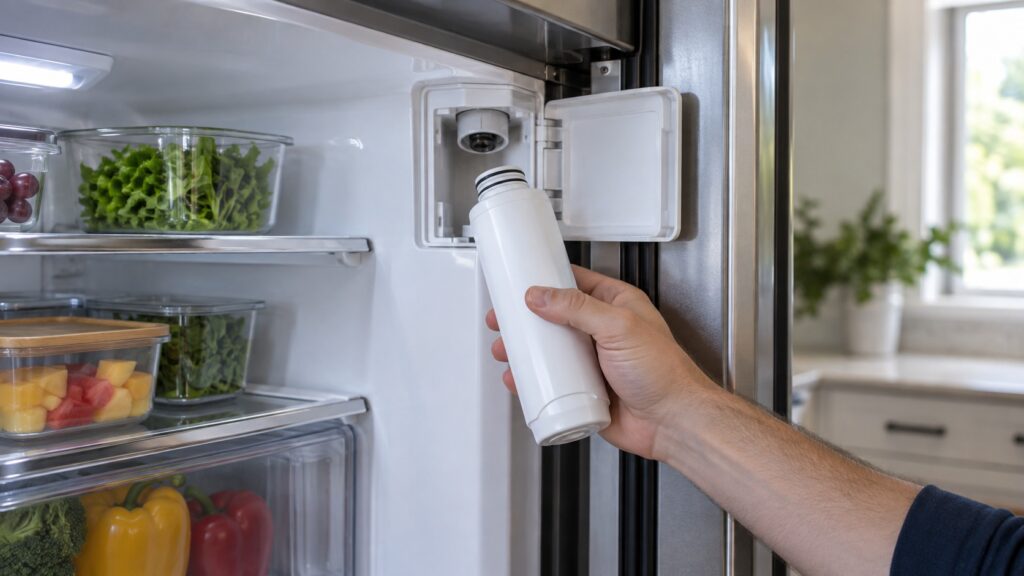
PureSource is Frigidaire’s water filtration system for refrigerators with a built-in water dispenser or ice maker — a replaceable cartridge that sits inside the fridge cabinet or behind the base grille and filters every gallon of water before it reaches the dispenser spout or the ice maker’s fill line. Knowing how it actually works helps explain two things owners run into constantly: why water flow slows down over months even though nothing looks broken, and why a fresh filter sometimes needs a few cycles before ice tastes normal again.
How does PureSource actually filter the water?
Water leaving the supply line passes through a sealed cartridge packed with activated carbon before it ever reaches the dispenser or the ice maker’s fill valve. Activated carbon works by adsorption: contaminants and chlorine byproducts stick to the enormous internal surface area of the carbon rather than passing through with the water. That is a physical and chemical process with a finite capacity — every gallon that passes through uses up a little of that surface area, which is the entire reason the cartridge is a wear part rather than a permanent fixture.
Why does water flow slow down as the filter ages?
As the carbon block accumulates trapped particulate over months of use, the same pores that do the filtering start to narrow, and the cartridge becomes more resistant to flow. A dispenser that took three seconds to fill a glass when the filter was new can take twice that long after several months, without anything having actually failed — it is the filter doing its job until it is worn out, not a malfunction elsewhere in the water system.
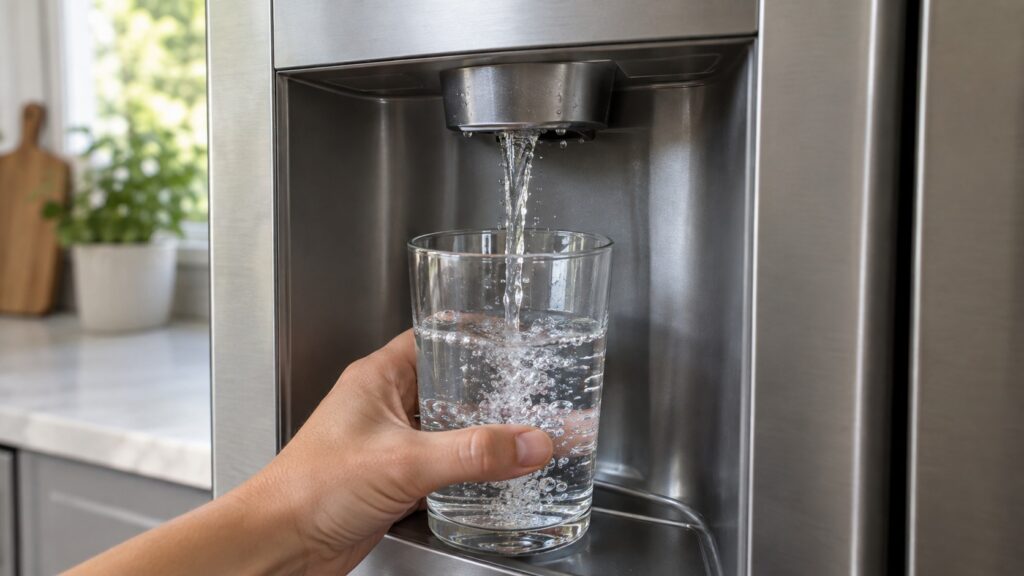
Does the filter indicator tell me when it is actually worn out?
Not directly. The status light or icon on most Frigidaire refrigerators estimates remaining filter life from elapsed time and dispenser use, not from a sensor reading the carbon’s actual condition. That estimate is a reasonable guide, but two households with different water hardness and different dispenser habits can wear out an identical cartridge at noticeably different rates. Treat the indicator as a reminder to check, not as proof the filter is still good.
Why does fresh water or ice taste off right after a filter change?
A new PureSource cartridge is dry inside, and air trapped in the housing needs to be pushed out before water flows cleanly. Frigidaire’s own guidance is to run several gallons through the dispenser after installing a new filter, discarding the first batch of ice as well, since it can carry a plastic or carbon taste from a cartridge that has not yet been fully flushed. That taste clears within a day of normal use in most cases.
Skipping that flush step is the most common reason a fresh filter gets blamed for a bad taste that was really just trapped air and carbon dust working its way out. Running the flush volume the installation instructions call for, rather than a token glass or two, makes the difference between a filter that tastes clean immediately and one that seems off for the first day of use.
What happens if the filter is never replaced?
Beyond the slowing flow rate, an exhausted filter eventually stops removing what it was filtering in the first place — at that point it is plumbing, not filtration. Some owners bypass a slow filter with a bypass plug rather than replace it; that restores flow immediately but removes filtration entirely until a new cartridge goes back in, which is a trade-off worth making deliberately rather than by accident.
An indicator that has been ignored for a long stretch is also easy to lose track of, since the light itself does not distinguish between a filter that is a week overdue and one that has been in place for two years. Checking the install date written on most cartridges, if one is visible, is a more reliable way to judge how overdue a change actually is than relying on memory alone.
Is a PureSource problem ever actually a water-line problem?
Sometimes. A cartridge that is seated correctly but still produces poor flow, or a dispenser that never recovers speed after a filter change, points upstream — to the water inlet valve, the supply line, or a kink in the tubing behind the refrigerator — rather than to the filter itself. Swapping filter after filter without improvement is the signal to look at the supply side instead. A twisted or pinched supply line behind the refrigerator produces the exact same slow-flow symptom as a worn-out cartridge, and it is worth pulling the unit out and checking the line before buying a second filter that will not fix anything.
A Frigidaire PureSource filter that seats correctly but still leaves the dispenser slow, even brand new, is one of the more reliable signs that the problem sits upstream of the filter rather than in it. The filter housing itself can also develop a weak seal over time, which shows up as a persistent drip rather than a change in flow speed — a different symptom that points at the housing gasket, not the cartridge.
Does a water softener or filtered supply line change the filter’s life?
Yes, usually for the better. A home already running a whole-house water softener or a pre-filter on the main supply sends water into the PureSource cartridge with less sediment and mineral content to begin with, which means the carbon block’s pores narrow more slowly and the six-month estimate can often stretch longer without a drop in flow. The reverse is also true: a home on well water with no pre-treatment puts more load on the refrigerator’s own filter, which is one of the more common reasons a household reports needing filter changes every three or four months instead of six.
When should you call for service?
Call when flow stays slow after a fresh Frigidaire PureSource filter, when the dispenser leaks around the cartridge housing, or when the indicator will not reset after a change. Our technicians carry PureSource-compatible cartridges and can also check the inlet valve and supply line if the filter turns out not to be the cause. We are an independent repair company, and pricing starts from a diagnostic visit with the estimate confirmed before any work begins.
For the temperature side of the same refrigerator, see how EvenTemp cooling works, and for storage layout see what SpaceWise means. If the refrigerator itself is not cooling, start with why a Frigidaire refrigerator stops cooling. Frigidaire refrigerator repair covers the water system, and you can schedule a visit any time.