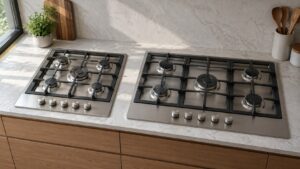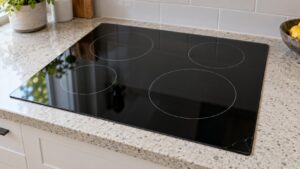

Here is how a Frigidaire induction cooktop works: a coil of wire under each cooking zone carries a rapidly changing current, which creates a changing magnetic field above the glass. That field makes electric currents flow in the base of a magnetic pan, and the pan heats up on its own. The glass is not the heat source, so it stays cooler than the pan, and a pan that is not magnetic will not heat at all. A fan under the glass cools the electronics, and the control checks for a pan before it starts to heat.
What heats the food on an induction cooktop?
The pan does. Under each zone sits a flat coil. When the zone is on, electronics feed that coil a rapidly alternating current, and the coil produces a magnetic field that passes through the glass. A pan with a magnetic base sits in that field, and the field makes currents flow in the metal of the base. Those currents warm the pan, and the pan warms the food. Because the heat starts in the pan, the glass is warmed mainly by the hot pan sitting on it. The glass can still be hot enough to burn you, so treat it as hot until it has cooled. Our model page for the FGIC3067MB lists a Hot-Surface Indicator, which is a light that warns you the glass is still hot; whether your model has one is in the owner’s manual, and the light is a reminder, not a reason to touch the glass.
Why does the pan have to be magnetic?
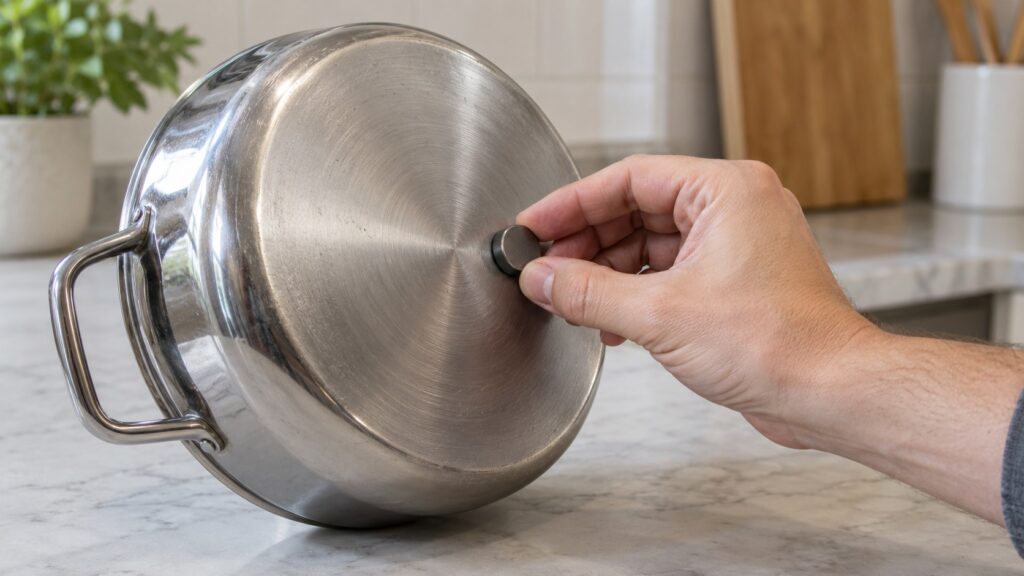
The effect works only on metal that responds to a magnetic field. Cast iron and many stainless steels do. Aluminum, copper, glass and ceramic do not, unless the base has a magnetic layer added. A simple test is to hold a small magnet to the bottom of the pan: if it sticks firmly, the pan is a candidate. Our cooktop cookware tips list a magnetic base such as cast iron or magnetic stainless steel for induction and say that the pan should be tested before the cooktop is blamed. If you use an implanted medical device, read the owner’s manual and ask your doctor about induction cooking before you use it.
How does the cooktop know a pan is there?
An induction zone does not heat with nothing on it, because the control senses the pan. Our model pages describe Auto Sizing pan detection on the FFIC3026TB and the GCCI3067AB, and the GCCI3067AB also lists a Bridge Element and TempLock. We describe those names as the site lists them, and the exact way each feature behaves on your model is in your owner’s manual. A pan that is too small, off center or not magnetic is the usual reason a zone does nothing, and that is a pan problem rather than a cooktop fault.
What do the power element and the settings do?
The FFIC3026TB is described on our site as a 30-inch cooktop with four induction elements, a 3,800W power element and a Melt and Hold setting. The older FGIC3067MB is described as an earlier-generation model with a 3,400W Power Assist element that we still service. The numbers on those pages are the manufacturer’s specifications for those models, so check your own model before you rely on them. A power element is simply a zone built to deliver more heat for tasks such as bringing a large pot of water to a boil, and a low setting such as Melt and Hold is for gentle jobs.
How does induction differ from radiant glass or gas?
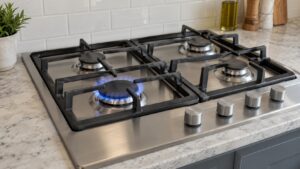
A radiant glass cooktop heats an element under the glass and passes the heat up through the glass into the pan, and a gas cooktop burns gas under the pan. Induction skips the middle step, so the pan responds quickly when you change the setting and no flame or glowing element is involved. The trade-off is the pan: a set of cookware that works on gas or radiant glass may not work on induction, and a flat, clean base matters. If you are comparing types before buying, our cooktop buying guide lays them side by side.
Why does an induction cooktop have a fan?
The electronics under the glass that drive the coils produce heat of their own. A fan moves air through vents to keep them cool, and if the fan is blocked or not running, the electronics can overheat. Our E6 code page describes a cooling-fan failure of this kind and rates it as needing a technician. Do not block the vents, and do not open the cooktop or touch anything under the glass.
Which error codes does an induction cooktop show?
Our model page for the FFIC3026TB says only induction models publish codes, limited to E1 or E6, a 5F sensor failure and an F40 or F41 lockout. E1 on our page means an element temperature sensor is reading out of range, E6 is the fan and F40 is the control lock, which clears once released and is not a failure. Our cooktop E1 and E6 guide goes through them. A cold zone is usually a symptom, not a code, and our element not heating guide covers it.