
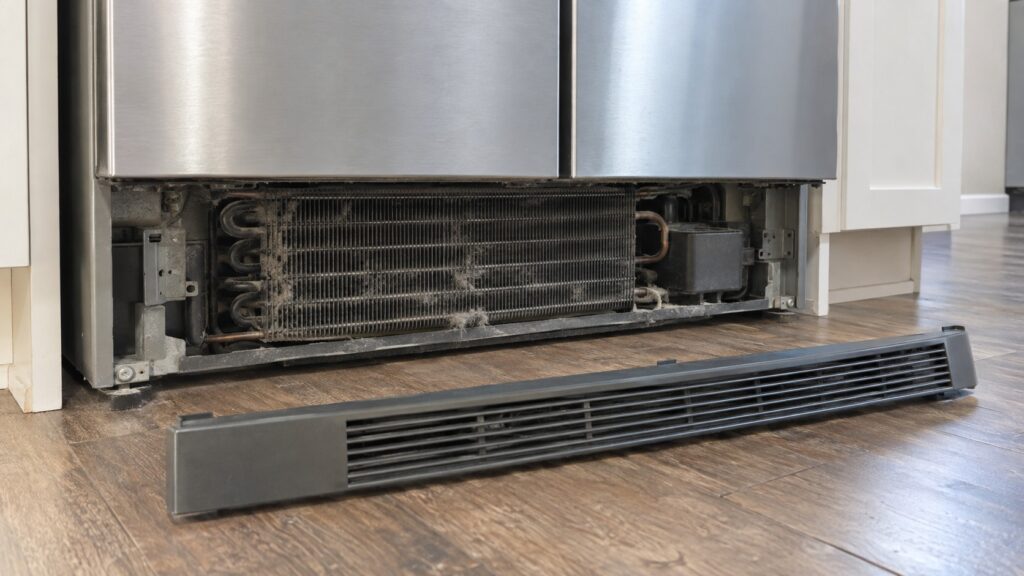
The condenser coils on a Frigidaire refrigerator release the heat the cooling system takes from the food compartments. When dust and pet hair coat the coils, that heat cannot escape well, and the refrigerator runs longer and can warm up. Cleaning Frigidaire refrigerator condenser coils is a brush-and-vacuum job at the bottom front or the back of the cabinet, done with the refrigerator unplugged or switched off as your owner’s manual describes. It does not involve opening sealed parts.
What do dirty condenser coils do to a Frigidaire refrigerator?
A coated coil acts like a blanket. The cooling system still pulls heat out of the food compartments, but the coil has trouble giving that heat to the room, so the compressor runs longer to get the same result. The usual signs are a refrigerator that seems to run constantly, a cabinet that is warmer than it was, and a lot of heat or noise from the bottom. If the compartments are warm, read our refrigerator not cooling guide as well, because dust is only one of several causes.
Where are the condenser coils on a Frigidaire refrigerator?
The location depends on the model. Many refrigerators keep the coils at the bottom behind a front grille, and others carry them on the back of the cabinet. We do not know which your model has from the name alone, so your owner’s manual is the source. In either place the coils are in the open air path, so you can reach them without taking the refrigerator apart. A fan near the coils moves air across them, and dust collects there too. The back of the refrigerator is a poor place to work alone, so pull the unit out only as far as you can do safely.
How do you clean them safely?
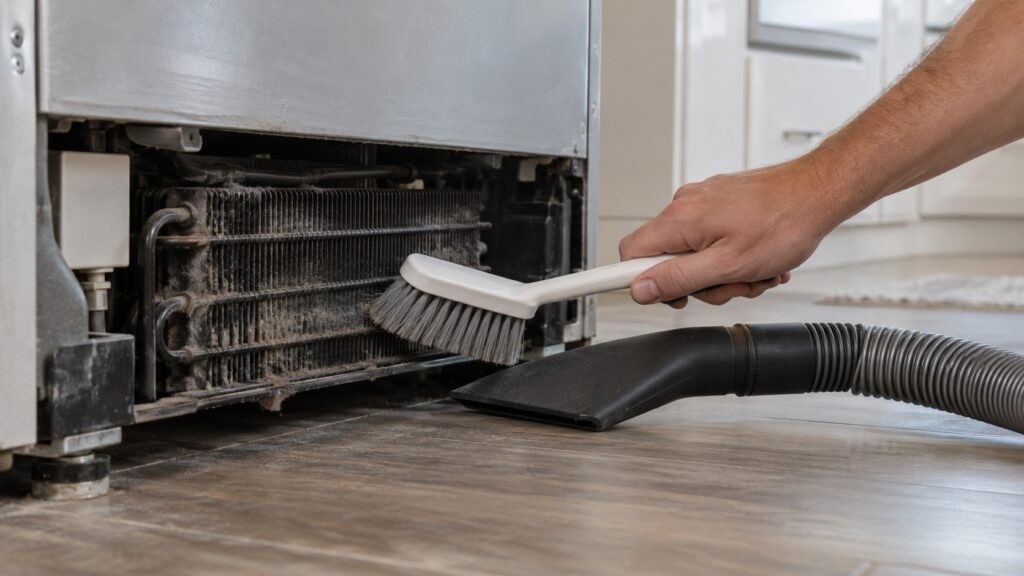
First stop the refrigerator from running. Unplug it if you can reach the plug dry, or switch the circuit off at the panel, and leave it off while you work. Move any rug or loose item away. If your manual allows you to take the lower grille off, it shows how; follow its steps and do not force the grille. Then use the soft brush to loosen dust from the coil and the space around it, and vacuum up what falls with the brush attachment. Work gently, because the tubing is thin and a bent tube is a repair.
Do not use water, a spray cleaner or compressed air that blows dust through the room and into the electronics. Do not remove any panel that is held with screws unless your manual says it is for you. Panels near wiring are for a technician.
How often should you clean the coils?
There is no one interval that fits every home. A house with pets, a dusty floor or a refrigerator in a garage collects dust faster than a clean kitchen. A sensible habit is to look at the coils whenever you move the refrigerator or clean the floor around it, and to clean them when you can see a coat of dust. Do it at the same time you wipe the door seal and replace the water filter. Our water filter replacement guide covers the filter, and the owner’s manual covers the seal. Keep a note of the date, because a coil that is clean today can be coated again by the next change of season, especially where a shedding pet shares the kitchen. Watching how long the refrigerator runs is a free early warning: a unit that seems to run all day is asking for attention.
What if the refrigerator is still warm after cleaning?
Give it time to recover, then check the simple things: a door that is open or does not seal, a full vent blocked by food, a temperature setting that was bumped, and a fan that is not turning. Check the setting on the control as your manual describes, because a setting that was bumped during cleaning is a common cause. If the coils are clean and the fan is running but the unit is still warm, the cause is a sealed-system, sensor or fan problem for a technician. A refrigerator display that shows a fan alert is described in our SY EF code guide. Keep food safe in the meantime and follow FDA guidance: a closed refrigerator holds its temperature for about four hours during an outage.
What else helps the coils and the fan work?
Keep the space around the refrigerator clear, because stored boxes and a tight cabinet recreate the problem you just fixed. Vacuum the floor under and beside the unit when you clean it, since the fan pulls floor dust straight into the coil area. If you hear the fan scrape or squeal after cleaning, stop and do not reach in with a tool, because that is a sign of a part that needs a technician. Set the grille back in place firmly so air moves through the intended path, and then plug the refrigerator in and check that it starts and that the compartments come back to temperature over the next day.
When should a technician do it?
Call when the coils are not reachable, when you see damage, oil or corrosion, when a fan is noisy or not turning, or when the unit stays warm after cleaning. Our Frigidaire refrigerator repair page explains the visit.