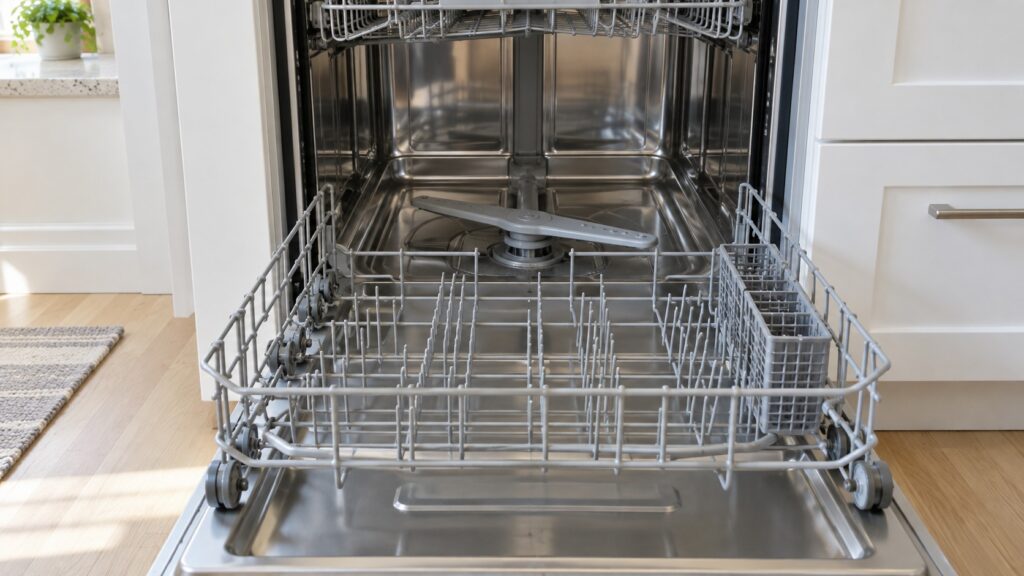
The frigidaire orbitclean spray arm is the part that decides whether a load comes out clean, and it earns its name by moving differently from an ordinary spray arm. A conventional arm spins on a fixed center and sweeps the same circular track every rotation. The OrbitClean arm sweeps that track and moves the track itself, so the jets cross the rack in an overlapping pattern instead of drawing the same rings again and again.
How does the OrbitClean spray arm actually work?
Water leaves the circulation pump under pressure and enters the arm through a central hub. The jets along the arm are angled, so the water leaving them pushes the arm around — the same reaction that spins a lawn sprinkler. Nothing motorized drives it; the wash arm is powered entirely by the water passing through it.
What Frigidaire changed is the geometry. Because the sweep shifts rather than repeating, a plate in the same rack position gets hit from several angles over a cycle rather than one. That matters most for the spots a fixed arm is worst at: the inside of bowls facing down, the backs of tall glasses, and the corners of the lower rack.
Why does the spray arm stop turning?
Almost always because something touches it. A cutting board leaned into the lower rack, a pot handle hanging through the tines, or a long utensil in the basket stops the arm on its first quarter turn, and the wash continues with water pouring out of a stationary arm onto one small area. Nothing warns you — the cycle finishes and half the load is dirty.
The second cause is the bearing at the hub. Over years, hard-water scale builds where the arm rotates, and a low water temperature makes that scale accumulate faster. An arm that has to be nudged by hand to move is an arm that the water pressure is barely turning, and it will stop entirely under load.
What blocks the jets, and how do I clear them?
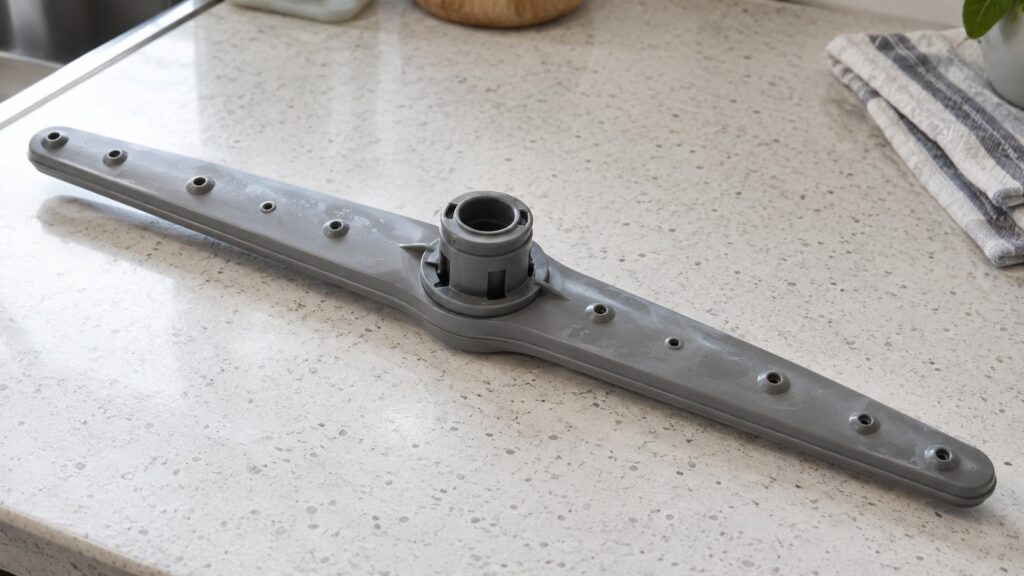
The jets are small on purpose — velocity is what carries water to the top rack — so anything that survives the filter can lodge in one. Fruit stickers, seeds, splinters of glass, and hard-water scale are the usual four. Run a finger along the arm and you will feel a blocked jet as a spot with no flow when the machine is running.
- Switch the dishwasher off and pull the lower rack out completely.
- Turn the arm by hand through a full circle. It should move freely, with no catch and no grinding.
- Lift or unscrew the arm as your model allows — most release with a quarter turn of the retaining nut.
- Clear each jet with a toothpick, never a metal pin, and rinse the arm from the hub end so debris comes out the way it went in.
- Soak a scaled arm in warm white vinegar for an hour before rinsing, then refit and confirm it spins freely.
🔴 Do the whole of that with the machine off, and do not reach into the sump area below. The drain pump impeller sits there behind a cover, and glass fragments collect around it.
How does DishSense change what the arm is asked to do?
DishSense reads how much soil is in the wash water and lengthens or shortens the cycle accordingly. That is why the same program can run forty minutes one night and ninety the next, and why people sometimes think the machine is faulty when it is simply working harder on a dirtier load.
The connection to the wash arm matters. If the arm is blocked or stalled, soil is not being lifted off the dishes into the water, so the sensor sees cleaner water than the load deserves and shortens the cycle. A stalled arm therefore produces a short cycle and a dirty load together, which reads as two faults and is one.
Is a dirty load always the spray arm?
No. The wash system is a chain: filter, pump, arm, water temperature, detergent. A clogged filter starves the pump, and a starved pump cannot spin the arm no matter how clean its jets are, so the filter comes first every time. Water below temperature leaves grease on everything regardless of coverage.
Our not cleaning guide works through that chain in order. And when the control has an opinion of its own, the i code glossary tells you which stage it is complaining about — i50 in particular names the wash or drain motor, which is the part that drives this arm.
What keeps the wash system working for years?
Three habits cover nearly all of it. Load so nothing hangs below the rack or leans across the arm’s path — spin the arm by hand after loading and before starting, which takes two seconds. Clean the filter on a schedule rather than when something goes wrong. And run the hot tap at the sink until it is genuinely hot before starting a cycle, so the first fill is not cold water the heater has to rescue.
Hard water deserves a fourth. Scale on the jets and in the bearing is the slow failure mode of any wash arm, and a rinse aid plus an occasional vinegar cycle does more for the OrbitClean arm than any detergent upgrade.
When should you call?
Call when the arm is free, the filter is clean and the load still comes out dirty, when the arm will not turn after the hub has been cleared, when the machine is noticeably louder during wash, or when an i50 code appears. Those point at the circulation pump or its motor rather than at the arm itself.
We are an independent repair company and not a factory service arm. Pricing starts from a diagnostic visit, from $89 in most areas, and we confirm the estimate before any work begins. Frigidaire dishwasher repair covers wash arms, circulation pumps, heaters and controls, and you can schedule a visit online or call (844) 440-7025.