
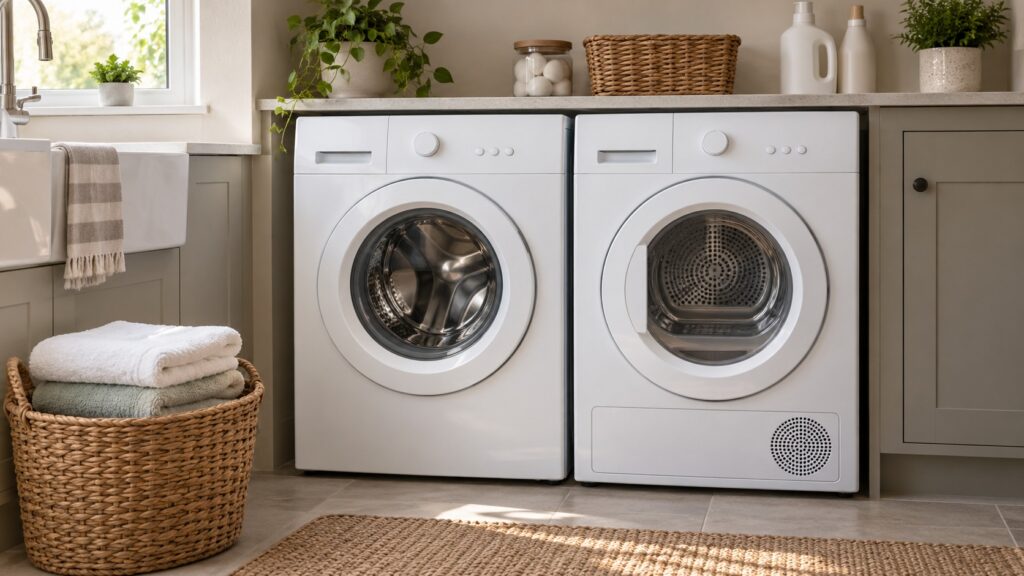
Frigidaire MaxFill is an option on some top-load washers that fills the tub to a deeper water level than the default, which helps with bulky bedding and heavily soiled loads. It is one of a dozen laundry terms that appear on the control panels and model pages of Frigidaire washers and dryers, and they are easy to confuse: Quick Wash, Energy Saver, Deep Fill, Stay Fresh, Sensor Dry, Wrinkle Release and more. This glossary explains each one in plain words, notes which models list it, and flags where a feature interacts with a fault code. Exact settings always come from your owner’s manual, because the same name can behave differently from one generation to the next.
What does MaxFill mean on a Frigidaire washer?
MaxFill is the washer’s way of letting you ask for more water. A high-efficiency top-load washer fills to a level sized to the load it senses, which is efficient for a mixed basket but sometimes shallow for a comforter or a pile of towels. Turning on MaxFill raises the fill so the load can move more freely and rinse more completely. Our model page for the FLVW7523BW lists it beside the 30-minute Quick Wash. Expect a longer cycle and higher water use when you select it, so keep it for the loads that need it rather than every wash.
Deep Fill, listed on the FLVW7000AW, is the same idea under a different label, and the two should not be run together on a washer that offers only one. If a washer with MaxFill reports a fill code, the option is not the cause. E11 means the water valve is filling too slowly and E13 is a water or air leak in the tub area, and our Frigidaire washer E11 guide explains what to check first.
What do Quick Wash, Energy Saver and Stay Fresh change?
Quick Wash shortens the cycle for lightly soiled laundry. The duration varies by model, so do not assume a number: the FLVW7523BW lists 30 minutes and the older FFFS5115PW lists 20. A short cycle uses less wash time, which is why it suits lightly worn clothes and not muddy sports gear.
Energy Saver is an option that lowers energy use, generally by reducing the heat or shortening the work the machine does to warm water. If clothes feel less clean than usual, the option may be the reason, and a normal cycle without it will tell you.
Stay Fresh appears as an option on the FFTW4120SW and FLVW7000AW top-loaders, and as StayFresh, an antimicrobial seal, on the front-load FFFW5100PW and FFFW5000QW. Both names are aimed at the same problem, which is a damp drum and a damp door seal turning musty between loads. The seal itself still needs wiping; our Frigidaire washer door seal guide shows how.
What is the difference between Sensor Dry, Moisture Sensor and Timed Dry?
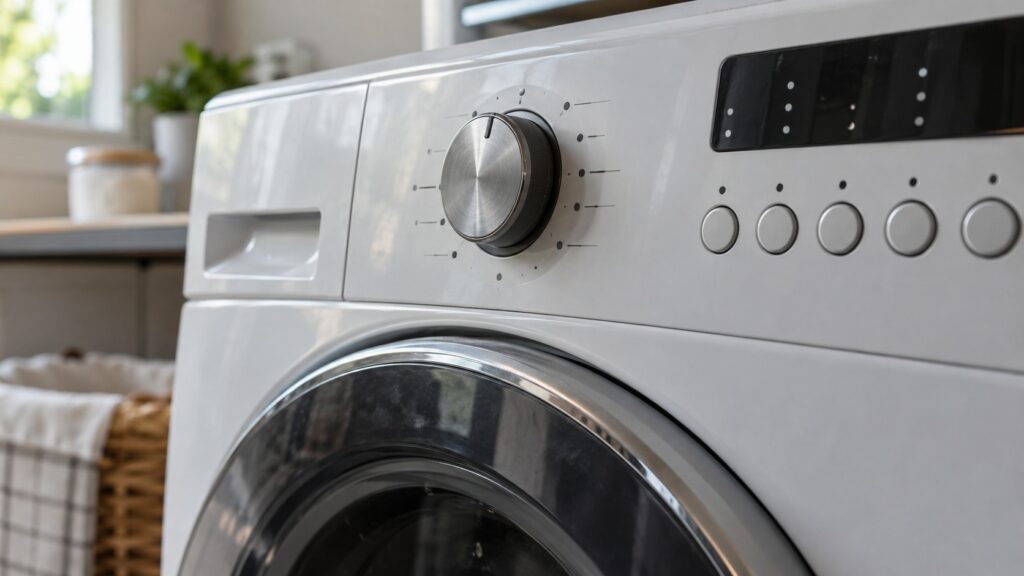
These three describe how a Frigidaire dryer decides it is finished. Sensor Dry, listed on the FLVE7523BW and FLVG7523BW, and Moisture Sensor, listed on the FFRE4120SW and FFRG4120SW, mean the same thing in practice: metal contacts inside the drum feel how damp the clothes are, and the control ends the cycle when they read dry. The older Gallery dryers call their sensor cycles Auto Dry, and a few carry a Precision Dry Moisture Sensor. Timed Dry ignores the sensor and runs for the minutes you set, which is the right choice for a single heavy item or a load you want only warmed.
The sensor depends on clean contacts. A film of fabric softener or lint on them makes damp clothes read as dry, so a load comes out cool and clammy. If your dryer ends early or runs long, read why a Frigidaire dryer takes too long, because a clogged vent is far more common than a faulty sensor. Our dryer how-it-works guide explains the heat and airflow side.
What do Wrinkle Release, Anti-Wrinkle and Quick Dry do?
Wrinkle Release and Anti-Wrinkle are finishing options. They keep the drum turning, with a little warmth on some models, after the main cycle ends so a load left in the dryer does not set into creases. Quick Dry is the dryer’s short cycle, useful for a small load but not a substitute for a full one. None of these options changes how well the dryer heats, so a dryer that shows no heat is a different problem: the codes for that are E5B, no temperature rise, and E64, an open heating element, while E8C is the high-limit thermostat tripping from overheating.
Which terms belong only to certain models?
Several labels appear on only a few models, and knowing them avoids buying the wrong part or following the wrong instruction.
- iCare Intelligent Fabric Care is listed on the older Gallery front-load GLTF2940FS.
- Ready Steam and its internal heater belong to the discontinued FFFS5115PW front-load steam washer.
- Tumble Action Cleaning System and Advance Rinse are listed on the FFFW5000QW.
- Vibration Control System appears on the FRFW3700LW and FAFW4011LW and refers to a design for steadier spins.
- Balanced Dry System is listed on the FFQE5000QW electric dryer.
If you are comparing machines for a purchase, our Frigidaire washer buying guide puts these terms in the context of top-load and front-load choices.
How do these features connect to Frigidaire error codes?
Options rarely cause codes, but they decide which codes you are likely to see. Washers group their alerts by system. E11 is a slow fill and E13 a leak. E21 is slow draining, usually a clogged pump filter, and E23 is a failed drain-pump relay on the control board. E41 is a door switch that reads open, and E42 is a door lock that will not release. EF1 is a prompt to clean the drain pump filter, and EF2 means over-sudsing from too much detergent. Dryers have a shorter list: EAF for the control board, E24 and E25 for the temperature sensor, E5B and E64 for no heat, and E8C for the high-limit thermostat tripping. When a code appears, note which option you had selected, because that detail helps a technician. If your washer will not empty, start with our Frigidaire washer will not drain guide, and if you need a visit, Frigidaire washer repair and dryer repair are the right places to begin.