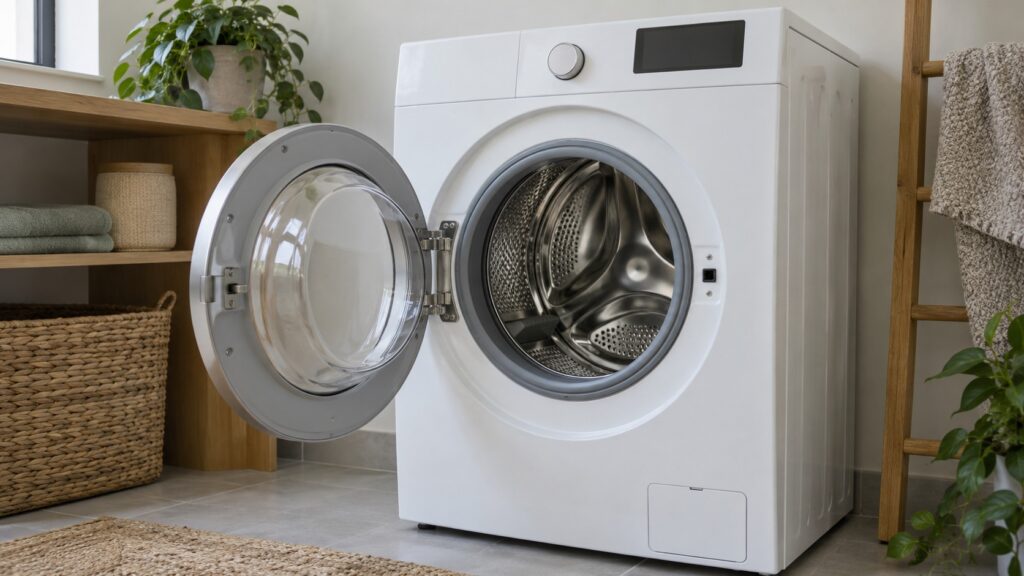
Here is how a Frigidaire front load washer works, in four steps: it fills the drum with a measured amount of water, tumbles the clothes through it by turning the drum on a horizontal axis, pumps the water out, and then spins the drum fast to pull water from the fabric. A door lock keeps the door shut during the cycle, a pressure-based sensor tells the control when there is enough water, an inlet valve lets water in and a drain pump sends it out.
What happens when you press Start on a Frigidaire front-load washer?
The control first checks that the door is closed and locked. A washer will not run while the control cannot confirm the door, which is why a latch that did not click is one of the most common reasons a cycle never begins. Once the door is confirmed, the inlet valve opens and water flows in through the detergent drawer, carrying detergent with it. A front-load washer is built to use far less water than an old top-load agitator machine, because the clothes are lifted and dropped through the water instead of floating in a deep tub.
How does the washer know how much water to use?
It does not measure by timing alone. A front-load washer watches the water level through a pressure sensor connected to the tub by a small air hose. As the water rises it squeezes the air in that hose, and the sensor reads the change. Our page for the Frigidaire E13 code describes this air-bell and pressure hose and says that a leak in that sealed air column gives a false reading. The fill time matters too. Our E11 guide explains that the control expects the target level within an allowed fill time, so a weak supply shows up as a fill code rather than as a slow wash.
How does the drum wash the clothes?
The drum turns slowly in one direction and then the other. Paddles molded into the inside of the drum lift the clothes up the side and let them fall back into the water. That repeated lift and drop is the washing action, and it is gentler on fabric than a central agitator. How long the drum turns and at what pattern is set by the cycle you pick; the cycle names and the exact patterns differ by model, so check your owner’s manual for what each one does on your washer. Bulky items and an unbalanced load make the drum work harder, which is why a half-full, evenly mixed load washes better than a tightly packed one.
How does it drain and spin?
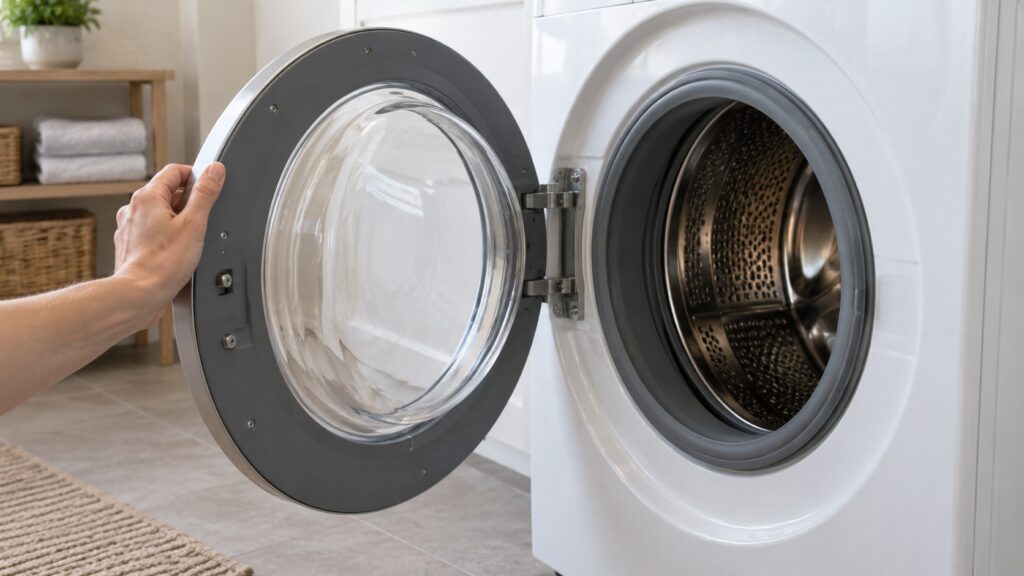
When the wash ends, the drain pump pushes the water out through a filter that catches coins, lint and small items. The drain filter and hose are the first places to look when water stays in the drum, and our E21 code page calls a clogged pump filter the usual culprit for slow or partial draining. After the drain, the drum accelerates and the spin presses water out of the fabric. The rubber door seal keeps the water inside the drum while it spins, and the fast spin is also what makes a front-load washer heavy on its feet, so the machine needs to sit level.
What does a heater or steam option add?
Some models add a heating element or a steam function. On our site the FFFS5115PW is described as a discontinued 10-cycle front-load steam washer with Ready Steam and an internal heater that we still service. The current FFFW5000QW is described as a 3.9 cu ft front-load washer with seven cycles and ENERGY STAR efficiency. Whether your model heats the water and what each cycle does with temperature is a question for your owner’s manual, so we do not state temperatures here. You can browse the front-load models we cover on the front-load washer product line page.
Which part causes which symptom?
Because each step has its own part, the symptom usually points to the step that failed. Water that never arrives points at the supply, the inlet screens or the inlet valve. Water that does not leave points at the drain filter, the hose or the pump, and a drain relay on the control board is a different, technician-level fault per our E23 page. A door that will not open after the cycle points at the lock, which our E42 page describes as a lock that does not confirm it has released. A shaking spin often points at load balance or an unlevel floor. Do not open the cabinet to look for these parts. Locks, boards and motors are a technician’s work.
How do you keep every step working?
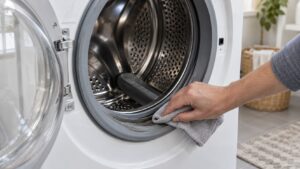
Most of the upkeep is on the parts you can reach without tools. Wipe the door seal and leave the door ajar so the drum dries, use HE detergent in the recommended amount, rinse the drawer and clear the drain filter as the owner’s manual describes for your model. Our washer maintenance guide and door seal cleaning guide take those habits one at a time. If water ever reaches an outlet or you see sparks or smell burning, switch off the breaker at the panel while standing on a dry floor and never pull a plug from a wet outlet.