Air fry arrived in ovens as a setting rather than a new appliance, and that confuses people who own a countertop air fryer and expect the same thing from a wall oven. The frigidaire air fry setting is a convection mode tuned for a particular job — moving a lot of hot air fast across food on an open rack — and understanding the mechanism explains both why it works and why results differ from the small machine on the counter.
The mechanism, briefly
Ordinary baking heats food mostly by radiation from the elements and by the still, hot air around it. That air forms an insulating boundary layer against the food’s surface, which slows everything down and is why a sheet of fries in a conventional oven goes soft before it goes crisp.
Convection adds a fan that moves the air, stripping away that boundary layer. Air fry pushes the idea further: more airflow, usually a higher fan speed, and a heat pattern chosen to drive surface moisture off quickly. Once the surface dries, it browns. That is the whole trick — crisping is a drying process before it is a browning one.
Why the pan matters more than the setting
A solid sheet pan blocks airflow from below, so the underside of the food sits in its own steam while the top crisps. You get a browned top and a soggy bottom, and people blame the oven.
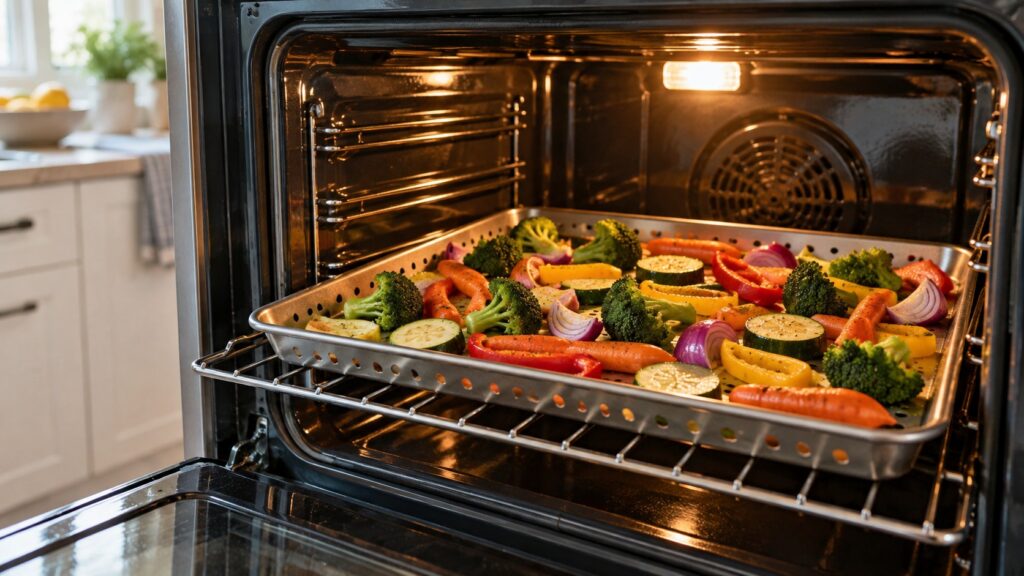
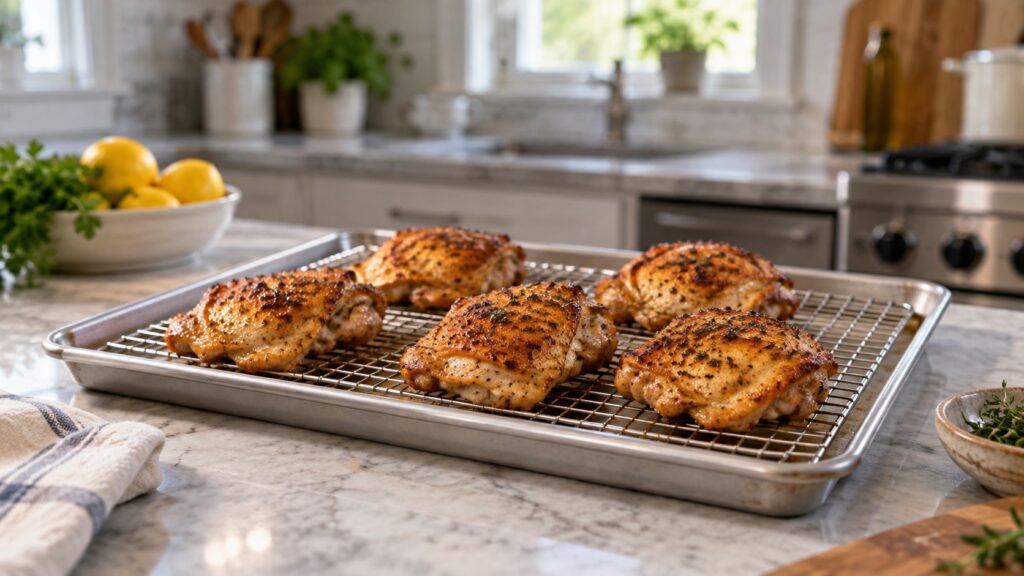
Use a perforated air fry basket if your model came with one, or improvise with a wire cooling rack set inside a rimmed baking sheet. Either arrangement lets air reach all the way around. Spread food in a single layer with visible gaps between pieces — a crowded pan traps moisture between items, and moisture is the enemy of the entire process.
Where it beats the countertop machine, and where it loses
The oven wins on capacity, and it is not close. A full sheet of wings or a whole tray of vegetables goes in at once, where a countertop fryer would need three batches. It also wins on not having another appliance on your counter.
The countertop machine wins on speed to temperature and on the intensity of airflow in a very small chamber, which shows up on small quantities of thin food. For one portion of fries it will still be quicker. For dinner for four it will not.
The oven also wins on something people overlook: you can use the rest of the oven. Air fry is a mode, so the cavity is the same cavity, and it is straightforward to move to a normal setting partway through.
Practical technique
- Preheat, even when it seems unnecessary. Food entering a cold cavity spends its first minutes steaming.
- Use less oil, not none. A light toss in oil helps the surface brown evenly; a dry surface can go leathery instead.
- Turn food once. Even the best airflow is not perfectly even, and one turn halfway is worth more than any setting change.
- Drop the temperature from a conventional recipe if it browns too fast, and expect shorter times than the same recipe on bake.
- Do not line the pan with foil under the food — you have just recreated the solid sheet you were avoiding.
What cooks well on it, and what does not
Anything you want crisp on the outside and already cooked or quick-cooking inside does well: frozen fries and nuggets, wings, halloumi, chickpeas, cubed potatoes, thick-cut vegetables, breaded cutlets, and reheated pizza slices that would otherwise go limp.
Things that do badly are worth knowing too. Wet batters blow off in the airflow before they set. Delicate greens and herbs scorch or get thrown around. Large roasts do not benefit, because the limiting factor is heat reaching the center rather than drying the surface. And anything with a lot of cheese on top will spatter into the fan housing.
What it does to the oven itself
High airflow across fatty food sends more grease into the cavity as aerosol than baking does, and it lands on the walls, the fan housing and the door glass. Wipe the cavity while it is still warm after air frying, and the residue comes off with a cloth instead of needing a cycle later.
That matters because heavy accumulated residue is what makes a self-clean cycle so hard on an oven — the cycle runs extremely hot to burn it off, and that heat is what takes out door locks, thermostats and occasionally control boards. Our self-clean guide covers doing it with the least risk.
When results go wrong
Food that will not crisp, with a clear pan and a single layer, points at the oven rather than the technique. Weak browning suggests the convection fan is not reaching speed or the element behind it is not working. Uneven results front to back can mean a fan issue or a door that no longer seals, which lets the moving air escape.
Food that browns far too fast on one side is worth checking against a thermometer, because an oven running hot will do that on every mode. Our calibration guide walks through measuring it, and our oven not heating guide covers the case where the heat is simply not arriving.
When to call
Call when the convection fan does not run or runs intermittently, when the oven will not hold the temperature you set, when the mode is unavailable on the control, or when you hear grinding or rattling from the fan housing at speed.
We are an independent repair company and not a factory service arm. Pricing starts from a diagnostic visit and we confirm the estimate before any work begins. Frigidaire oven repair covers elements, fans, sensors and controls, and you can schedule a visit online.