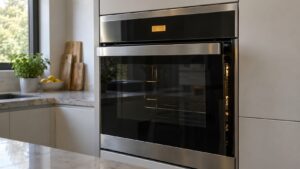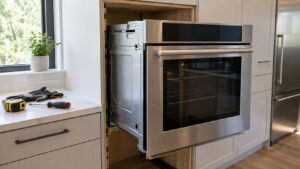
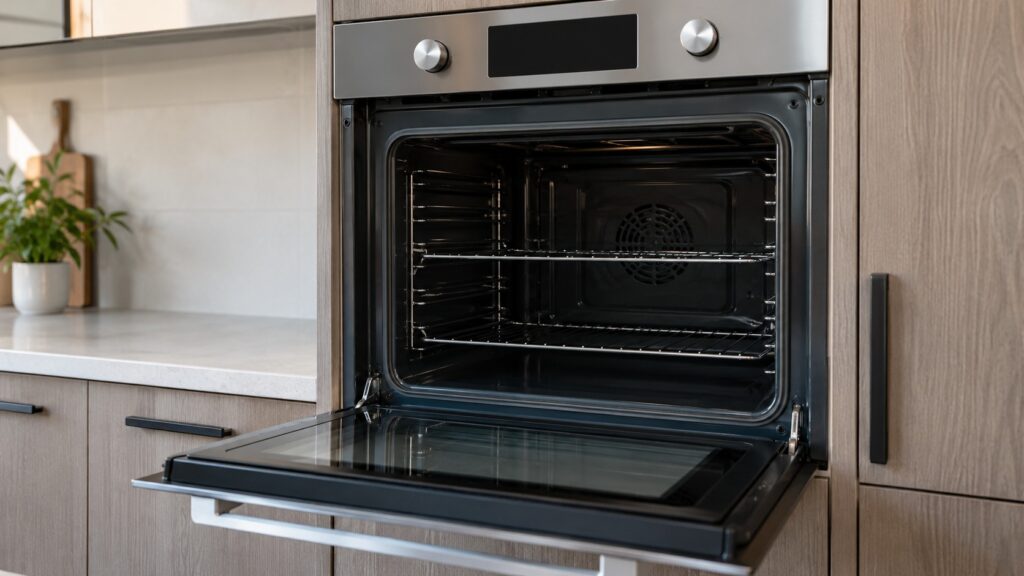
On a Frigidaire wall oven repair or replace question, repair is usually the right call when the fault is a single contained part such as the temperature sensor, the keypad or the door-lock motor, and replacement is worth considering when the oven is old, has several failing systems at once, or keeps throwing a safety code after repairs. A wall oven is a built-in appliance, so replacing one also means cabinet cutout, wiring and fit, and that raises the bar for a replacement. The age of the oven, the cost of the parts compared with the cost of a new unit, and the code history are the three things to weigh.
Should you repair or replace a Frigidaire wall oven?
Start with what the oven is telling you. A wall oven that fails to heat evenly, shows a code or has a door that will not unlock is describing a specific part, and most of those parts can be replaced without touching the rest of the oven. The question becomes a question of age and of how many separate problems you now have. One failed part on an oven that is otherwise solid is a repair. Two or three unrelated faults in the same year, on an oven that is already well past mid-life, points the other way.
Frigidaire wall ovens on this site include built-in singles such as the FFGW2426US, a 24-inch single gas wall oven with a 3.3 cubic foot cavity, and electric models like the FFEW2426US. The model number you find on the label tells a technician which controls and which parts your oven uses. Our Frigidaire wall oven installation guide explains how those cutouts and circuits work, which matters if you are weighing a replacement.
Which wall oven problems are usually worth repairing?
These are the faults that most often justify a repair on a sound oven:
- A temperature sensor fault. The F30 and F31 pages on this site list the oven temperature sensor (RTD), its harness and connector, and the electronic oven control as the components involved. The repair is often mixed: some parts are a simple swap, and others need a technician.
- A door-lock fault. F90 and F91 point to the door-lock motor, the latch assembly and the latch switch. These are mechanical, contained parts, so the oven is rarely at fault as a whole.
- A keypad that does not respond. F1 and F11 point to the touch keypad and its ribbon. A new keypad restores the oven, unless the electronic control behind it is also failing.
Our guides on the Frigidaire oven F30 code and on the F90 and F91 door lock explain what each code points to, and the Frigidaire oven not heating guide covers the symptom without a code.
Which problems push you toward replacing the oven?
Three situations deserve a serious look at replacement. First, an electronic oven control with a memory fault, which is what the F13 page describes, can be a larger repair on an older oven because the board runs everything. Second, an oven with a repeated F10, which the model pages describe as a safety-critical temperature runaway, needs a technician to find the cause, and an oven that comes back with the same safety problem is a reason to think hard about its remaining life. Third, structural damage, such as a cracked cavity, a warped door or a failing hinge, is hard to fix at a reasonable price.
If an F10 appears, turn the power off at the breaker and do not use the oven until it is repaired. Do not try to run a self-clean cycle to clear it. The Wall Oven F10 page explains why that code is treated differently from the others.
How does age change the decision?
Age matters because parts for a discontinued oven can be harder to get, and because older ovens tend to develop several problems close together. Ask yourself whether the oven has been reliable until now. A reliable oven with one failed part is a good repair. A tired oven where each repair is followed by another one is not. Note, too, that a replacement oven is not just the price of the unit: you need to account for the cutout, the electrical or gas connection and the trim, which is why a wall oven is replaced less casually than a freestanding range. Our Frigidaire range repair or replace guide applies the same logic to freestanding ranges.
What should you do before you decide?
Get a diagnosis first. Write down the code, if there is one, note when the fault started and photograph the rating label. Then have a technician check the oven rather than guessing from the symptom, because a bake problem can be a sensor, an element or a control, and the three have very different outcomes. A power reset at the breaker is a safe thing for you to try once; opening the oven’s panels is not, because the terminals behind them carry household voltage. If a replacement is the plan, our Frigidaire oven buying guide helps you compare the options, and oven temperature calibration is worth a check on any oven you keep, because an offset is not a reason to replace it.