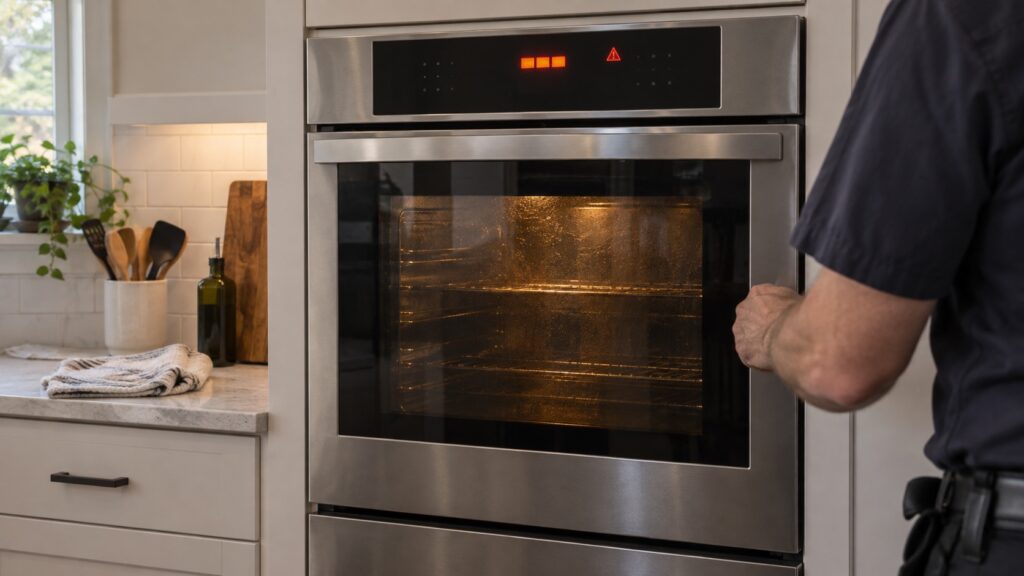
A frigidaire oven f90 code means the self-clean door-lock motor will not unlock the wall oven, and F91 means that same motor has used up its allowed unlock attempts. Both are about one small mechanism at the top of the door frame: a motor, a cam, and two switches that tell the control where that cam is standing. Nothing about either code says the oven cannot bake. It says the door will not open.
Why does a Frigidaire wall oven lock itself at all?
Self-clean works by heat — the cavity is driven far above any cooking temperature until soil turns to ash. An oven at that temperature is not something anyone should be able to open, so the control drives a small motor that turns a cam and throws a steel latch across the door. Two switches report back: one for the latch position, one for the door itself.
The control refuses to release the latch until the cavity sensor reads a safe temperature. That is why a lock code often appears hours after the cycle rather than during it — the oven has cooled, the control has asked for an unlock, and the mechanism has not answered the way it expects.
What is the difference between F90 and F91?
F90 is the first report: the unlock was commanded and the switch that confirms an unlocked latch never closed. F91 is what the control writes after it has retried and given up. In practice you will often see one turn into the other if the oven is left alone, which is why both codes share a diagnosis.
The useful distinction is mechanical rather than electronic. F90 on a fresh cycle, with the cam clearly stuck part-way, usually means binding — grease that carbonized during the clean, or a latch fouled on a warped door liner. F91 on an oven that has thrown the same code repeatedly points at the motor or the switch that is meant to confirm its position.
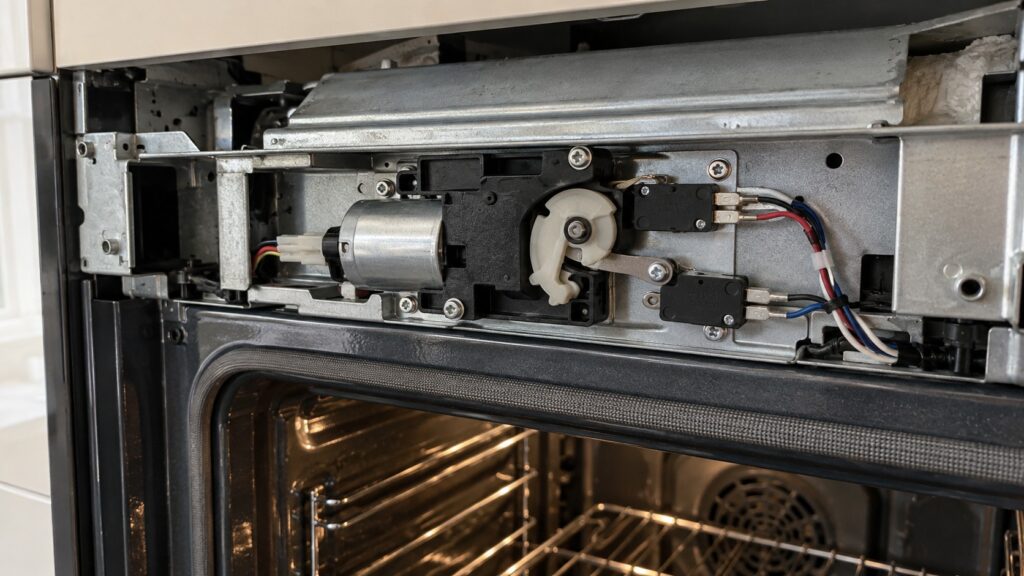
What can I safely try before calling?
There is one sequence worth running, and it has a strict order.
- Let the oven cool completely. Give it three hours from the end of the cycle. A hot cavity sensor blocks the unlock by design, and every attempt made while it is hot counts toward the retry limit behind F91.
- Cut power at the breaker for five minutes. Not a quick flick — the control needs to fully discharge and restart its own routine.
- Restore power and leave the panel alone while it boots. Do not start another clean cycle to “reset” the latch; that is the most common way a stuck door becomes a stuck door with a baked-on mechanism.
- Try one normal bake at a low setting. On many controls the unlock is attempted again at the start of a program.
- Stop after two tries. Each failed attempt is logged, and repeated commands to a jammed motor are what burns it out.
🔴 Do not attempt to reach the latch mechanism through the top of the door or by removing the control panel. The oven’s line voltage terminals sit directly behind that panel, and the door itself is heavy enough to fall out of its hinges when the latch is disturbed.
Is the door lock related to other oven codes?
Only loosely, and it is worth knowing where the line falls. Codes about the temperature sensor circuit, like the one covered in our F30 guide, describe the control reading the cavity wrongly — and a control that cannot read cavity temperature will also refuse to unlock, because it has no way to prove the oven is cool. That is the one path by which a sensor fault shows up as a locked door.
A wall oven that does not reach temperature at all is a different subject entirely, and our not-heating guide is the right starting point for that. If your oven both fails to heat and refuses to unlock, assume the sensor circuit first.
Does this happen on some wall ovens more than others?
It happens most on ovens that run self-clean rarely and then run it on a heavily soiled cavity. A latch that sits in one position for two years, then is asked to move through carbonized grease at the end of a four-hour clean, is the classic F90 candidate. Double wall ovens add a second complete lock assembly, so there are two of everything to go wrong, and the code alone does not tell you which cavity reported it — the display does. If you are comparing a double against a single, our FCWD3027AS and GCWS3067AF comparison lays out what a second cavity adds and what it costs you in serviceable parts.
The practical habit that prevents most of this: wipe heavy spills out by hand before running a clean cycle, and run a short clean once or twice a year rather than a long one every few years. A mechanism that moves regularly does not seize.
Timing helps too. Start a clean cycle in the morning rather than last thing at night, so the oven finishes and cools while somebody is still in the house to notice a door that has not released. A lock code found at breakfast is a service call; the same code found at midnight before a holiday is a ruined day of cooking.
When should you call for service?
Call when the door is still locked after a full cool-down and a proper power cycle, when the latch is visibly stuck part-way, when the motor can be heard running without the latch moving, or when the code returns on every program. Those are the cases where the lock motor, a switch or the harness has to come out, and the door has to be supported while that happens.
We are an independent repair company and not a factory service arm. Pricing starts from a diagnostic visit, from $89 in most areas, and we confirm the estimate before any work begins. Frigidaire oven repair covers door locks, sensors, elements and controls, and you can schedule a visit online or call (844) 440-7025.